











Tuesday Marketing Notes (Number 61—December 5th, 2006)
A B2B Marketing Newsletter for BMA Members
____________________________________________________________
MAKE SURE YOU CONTINUE TO RECEIVE EACH ISSUE OF TUESDAY MARKETING NOTES—CLICK HERE TO RENEW YOUR FREE SUBSCRIPTION
(NOTE: if you’ve already signed up previously at this link above, no need to do so again)
INDEX TO PAST ISSUES OF TUESDAY MARKETING NOTES:
Click here
Special Savings Promotion for BMA Members—Click here
–––––––––––––––––––––––––––––––––––––––––––––––––––––––
How to Write a Great Sales Letter (Part 4: Writing the Letter for the Big Sale)
by Eric Gagnon
Last week, we began the process of writing a sales letter for the high-level sale. This is the introductory letter, usually written to a CEO or other top executive in the company you’d like to do business with in a big way—a major account, a licensing or co-marketing deal, or a joint business venture.
In last week’s TMN, (accessible here)
. . . we started the first half of the letter by:
- Stating the reason we were writing;
- Introducing our company and summarizing our proposal;
- Summarizing our proposal’s single major benefit;
- Making our presentation in brief
. . . now, let’s complete the rest of our letter . . .
5.) Share the vision
Once you’ve laid out the benefits of your proposal and made your presentation in brief, your next paragraph shares the vision of the benefits you’ve described. Describe to the CEO how the deal you’re outlining helps his company:
• Strengthen its strategic position;
• Generates substantial added revenue, with little downside risk (low-risk, low-cost profit centers are a very compelling appeal when making high-level presentations—see below);
• Requires little cost, effort, or resources to develop (if this is the case)
The last two points above—new profit centers and low buy-in costs—are extremely powerful and compelling benefits to CEOs and other senior company executives, who live every day with the headache of boosting their sales and squeezing every nickel from expenses in their business units. If the deal you’re presenting has these advantages, don’t hesitate to put this right up front in your letter.
In the next paragraph of our letter, we share the vision:
By licensing our Cerampress technology, and incorporating Cerampress products with your existing valve systems product line, GXE establishes a brand-new profit center business line serving many new applications in hazardous fluid materials processing, with minimal start-up and tooling costs. Most important, by licensing our technology GXE achieves a critical strategic and technological advantage against its competition in ceramics-based materials.
6.) Now, tell the CEO what you want
Next, make it plain to your reader what you want to do as a next step. Usually, the purpose of this initial sales contact letter is to set up a meeting where you’ll make the presentation which expands on the points you have just outlined in your letter. Here is an example:
We look forward to having the opportunity to meet with you to provide an in-depth presentation, detailing how our company’s Cerampress technology and product line can work with GXE valve systems to offer your company new incremental sales revenues, and your customers a revolutionary new efficiency and savings in their fluid-handling applications.
This statement gives both of you a tangible objective for your next step. If you tell the CEO what you want to do next, then you make it easy for him to delegate the set-up and scheduling of your meeting to someone else.
7.) Describe your enclosures
Now that you’ve made your initial presentation, tell the CEO what else is in the package you sent, and what these materials describe. You are doing this for two reasons: To tease the CEO into looking at these materials, and—as important—since a CEO who finds your letter of interest usually scribbles a quick note in the margin of your letter with instructions to forward it along to a staffer or another department in the company for follow-up—this description serves to document what you are sending in your package, so the CEO’s secretary or assistant will make sure to include all of these materials when they are forwarded along to the contact person the CEO has delegated to work with your company.
Here’s a description of the enclosures for our sample letter:
The enclosed materials provide additional information on our company and Cerampress technology and products, and includes some additional technical independent test results on our ceramic bonding technology, which will be of interest.
8.) Tell the CEO what you are going to do next, and be sure to do it
Finally, tell the CEO what your next step will be. Usually, your next action is to follow up by phone in about a week. Listing a specific date and time you (or your company’s Sales VP) will be calling, and making sure to call at that time tells the CEO that you will do what you say you are going to do—an important first step in establishing trust in a new business relationship:
I will call you at 10:00 AM on Thursday, September 30th to further discuss this opportunity with you, and to set a date and time for a meeting. Meanwhile, if you have any questions or need further information, please feel free to call me at: (888) 555-4826.
To download and view this sample sales contact letter in its entirety (.PDF format), click here . . .
Scouting New Deals and Filling the Your Company’s Deal Pipeline Gives You a Place at the Table
Crafting the sales contact letter that communicates the points of the big deal is an important and prestigious assignment for any marketing professional. Your success in this task, working alongside your company’s CEO and VP of Sales to draft sales and proposal letters, and to develop the high-level presentations that follow, makes you an valuable part of the process of building sales and expanding new business opportunties for your company. Scouting new high-level sales and business development opportunties, and making contacts in your field by sending sales letters like these, keeps your company’s deal pipeline loaded with new contacts and opportunities.
Closing one, two, three or more of these big deals a year also creates new marketing opportunities in your program, since these big deals often require joint marketing initiatives, such as cooperative advertising, mailing, and prospecting programs, to make the deal work. And more marketing projects that create more sales are always a good thing!
Getting involved in these high-level strategic marketing activities that help your company “do the deal” lifts your profile in your company, and by helping you play an instrumental role of making the sale, goes a long way to closing the “sales and marketing gap” that exists in many companies today.
One More Thing . . .
Finally, here is some invaluable sales letter-writing advice from the late Ray Jutkins, a direct mail copywriter, speaker, and marketing consultant . . .
Eight Golden Guidelines for Writing the Perfect Sales Letter
by Ray Jutkins1.) The best way is the simple way. Write it like you say it. Don’t worry about grammar. Don’t concern yourself with punctuation (we overuse it anyway). Don’t wordsmith every sentence. Make it human.
2.) The best mail is personal mail multiplied. Write to your Aunt Minnie (or if you don’t like Auntie M., then your favorite somebody). And do it over and over and over to others. It works.
3.) If your audience is octogenarians in Oshkosh then you become an octogenarian in Oshkosh. Pretend you are the recipient and write to yourself.
Plumbers don’t respond the same as doctors, teenagers differently from grandparents, presidents of large companies differently from those of smaller firms, women from men, musicians from architects.
Write to your audience, talk to them with whatever common denominator is available, Put yourself in your reader’s frame of mind.4.) Never, but NEVER talk down to your audience. Look them straight in the eye, aim at them directly. Or even better yet, look up to them.
5.) Do not tell a lie. Be honest, straightforward, up front, true. Tell a funny story, be entertaining, weave a theme to make your point, play games any way that will help your cause, but do not tell a lie. Ever.
6.) Have something to say. This may seem funny to have to say, but many letters don’t say anything. Have something specific to say, a message, and then say it. Don’t beat around the bush—come out with it.
7.) Make an offer. The offer says if you do this now these good things will happen to you now. The offer is the reason a certain percentage of your audience will respond—and it many times is the difference between success or failure. Move those “considering” you to your side with a good offer.
8.) Ask for the order! Be specific—ask your audience to do something. Don’t just hint. Spell it out in spades.
Questions? Comments? Send them to me at eric@realmarkets.net
___________________________________________________________
Attention Marketing Managers:
Get a Second Opinion on Your Marketing Program. . . FREE
Think you should be spending less and getting more from your current marketing program? Tired of hearing empty “branding” promises from your ad agency that never seem to translate to actual, measurable sales results?
Or, have you been losing out on important new selling opportunities due to poor execution in your marketing projects?
Let us give you a second opinion on your current B2B marketing program and deliverables, at no cost or further obligation.
For more information, contact us at: ericgagnon@verizon.net or click on this link below:

_____________________________________________________________
Eric Gagnon (eric@realmarkets.net), is president of GAA (www.realmarkets.net), a sales and business development consulting firm, and is the author of The Marketing Manager’s Handbook, the master study guide for the Business Marketing Association’s Marketing Skills Assessment, Skill Builder, and Certification (MSA/B/C) programs.
For more information on The Marketing Manager’s Handbook, available to BMA members at a special discount, link to:
http://www.businessmarketinginstitute.com/book.html
_____________________________________________________________
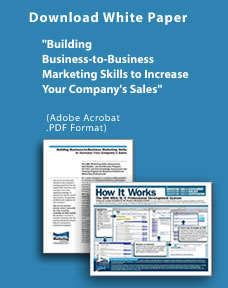
Test, Train, and Build Your B2B Marketing Skills for Better Sales Success: BMA Announces New Assessment, Training, and Certification for B2B Marketing Managers
For more information on the new BMA Marketing Skills Assessment, Skill Building and Certification (MSA/B/C) training and professional development program, visit http://www.businessmarketinginstitute.com