











Tuesday Marketing Notes (Number 60 —November 28th, 2006)
A B2B Marketing Newsletter for BMA Members
____________________________________________________________
MAKE SURE YOU CONTINUE TO RECEIVE EACH ISSUE OF TUESDAY MARKETING NOTES—CLICK HERE TO RENEW YOUR FREE SUBSCRIPTION
(NOTE: if you’ve already signed up previously at this link above, no need to do so again)
INDEX TO PAST ISSUES OF TUESDAY MARKETING NOTES:
Click here
Special Savings Promotion for BMA Members—Click here
–––––––––––––––––––––––––––––––––––––––––––––––––––––––
How to Write a Great Sales Letter (Part 3: Writing the Letter for the Big Sale)
by Eric Gagnon
In the last two weeks, our discussion of writing techniques for sales letters has focused on writing sales letters sent as part of direct mail projects, in sales follow-up kits, and other promotionally-oriented projects. These are the majority of the letter-writing projects in your marketing program.
Now, let’s talk about how these skills can be applied to one of the most career-boosting, sales-building activities you’ll be involved in as a marketing professional. This is the process of outlining and writing the highest form of sales letter: The sales contact letter for the major potential account sale, the major business development relationship, technology licensing proposal, or other big deal.
The contact letter for the high-level sale introduces your company, its product, and the benefits or your product to the top executive at your target company, and it establishes the parameters of your proposal, and of your business deal. A clear, persuasive, professional letter makes a positive first impression with the executive at the target company, and invites follow-up for further discussions.
Sales Letters for High-Level Sales Differ From Other Sales Letters
Sales letters written for the high-level sale differ from most of the sales letters you produce or write for your company in several important ways. First, since they are written for a single, specific reader (usually a CEO or other top-level executive at your “target” company), they are obviously much less promotional in their tone and format, which means they don’t have the same loose promotional-sounding tone in copy you’d use for a sales letter mailed as part of a larger mailing. These letters must be written in a crisp, businesslike tone, and they must make it easy for an extremely busy CEO to understand the gist of what your company is about, and what you’re proposing.
Second, these letters are often passed along from the CEO to his staff or department heads for further follow-up and action, so the points you make in these letters must be crystal clear when read by someone who probably hasn’t heard of your company before. This applies as well to any action items in the letter, which must be written clearly enough so they can be clearly followed up on as action items by the person to whom the letter has been passed.
Third, when these letters involve possible licensing of your company’s patents or other IP, they must also be reviewed by your company’s attorney, since what you say in this letter may be held against (or for) your company in the future.
Typical High-Level Sales Letter Outline and Example
Like any other marketing project, there’s no mystery to writing an effective sales letter to a CEO or other top executive: Clear communication, a focus on what’s important to your reader, and a clear expression of what you want to achieve with your proposal, and of the next step you are asking the reader to take with you, are the essence of writing a letter that gets your company in front of the CEO and his team to make the presentation and do the deal.
Here is an outline, along with an example of a typical letter you’d write (or ghost-write for your client) addressed to a CEO of another (usually, much larger) company, to propose a joint selling and business development relationship . . .
1.) State the reason you are writing
In your opening, state clearly why you are writing, and if this letter is a followup to any other contact between the letter-writer and your reader, since these letters sometimes document initial phone calls between you, your CEO, sales VP, or other senior executive, and the CEO or other high-level counterpart at the target company. This could also be a referral from a mutual contact, or an article you’ve read about the target company in a trade publication which prompted you to write.
So tell your reader what prompts you to write this letter, and why you are writing it. Here is an example:
We are writing to introduce our company to you, and to outline a brief proposal of ways we can work together to help GXE increase its sales of valve systems to current and prospective customers, and open new markets in fluid process applications.
2.) Introduce your company and summarize your proposal
In the next paragraph after your opening, briefly introduce and describe your company, and then describe your proposal.
Carrying on with the next paragraph in our sample letter, here’s an example:
Our company, Duramco, has developed Cerampress, a patented new ceramic valve liner process and technology used for fluid-handling applications in high pressure, heat, and chemical processing environments, which can be offered as a value-added technology and service installation business by your company to your existing and new customers.
3.) Summarize your proposal’s single major benefit
In your next paragraph, summarize your proposal by presenting your product’s major benefit,and describing how this benefit helps the CEO’s company. This is the most important paragraph in your letter, because it’s the grabber that gets your reader to continue skim-reading the rest of your letter. If this paragraph is effective enough, your busy CEO reader may even stop reading here and pass it along to a staffer or department head for follow-up. Again, you are telling your CEO reader what’s good about your company and your deal, and—most important—how your proposal is good for the CEO’s company:
Cerampress technology can be a new source of additional profit center revenue for GXE. By licensing our technology for use in retrofit applications and new plant installations, and offering Cerampress products as an upgrade to your current valve systems line, GXE can increase its per-unit sales volume to your current customers as part of your existing sales and marketing effort, without added expense.
4.) Expand these benefits—make your presentation in brief
Use no more than three bullet points to present your proposal’s major points. Describe both the nature of your proposal, and its advantages to the CEO’s company. For example, outline the major examples of how the CEO’s company and its customers would utilize your company’s product, and how this benefits the CEO’s company:
Here are a few examples of how your customers and GXE benefit from our company’s Cerampress technology:
• Retrofit capability cuts upgrade cost and saves plant downtime on installation: Cerampress ceramic valve liners can be offered as a retrofit to your customers’ existing installations, opening many new opportunities for your sales team to sell to accounts who are not yet ready to fully upgrade their fluid processing systems;
• Longer wear and 40% greater reliability: In retrofit or new installations, Cerampress ceramic valve liners save plant maintenance expense and give your customers reduced plant downtime. Independent testing proves 40% greater MTBF for Cerampress ceramic materials vs. existing alloy or high-density plastics for corrosive, high-heat or other challenging fluid-handling applications;
• Fully compatible with the GXE product line: Because Cerampress is fully compatible with GXE’s full line of extreme-use valve assemblies and hydraulic systems, integration of our patented technology with your existing product line is seamless, and we can train your service and engineering staff in a very short time.
Next week, we’ll cover the next most important aspects of writing high-level sales letters: Sharing the vision, telling the CEO what you want, and sure-fire follow-up techniques for getting the meeting. . .
___________________________________________________________
Attention Marketing Managers:
Get a Second Opinion on Your Marketing Program. . . FREE
Think you should be spending less and getting more from your current marketing program? Tired of hearing empty “branding” promises from your ad agency that never seem to translate to actual, measurable sales results?
Or, have you been losing out on important new selling opportunities due to poor execution in your marketing projects?
Let us give you a second opinion on your current B2B marketing program and deliverables, at no cost or further obligation.
For more information, contact us at: ericgagnon@verizon.net or click on this link below:

_____________________________________________________________
Eric Gagnon (eric@realmarkets.net), is president of GAA (www.realmarkets.net), a sales and business development consulting firm, and is the author of The Marketing Manager’s Handbook, the master study guide for the Business Marketing Association’s Marketing Skills Assessment, Skill Builder, and Certification (MSA/B/C) programs.
For more information on The Marketing Manager’s Handbook, available to BMA members at a special discount, link to:
http://www.businessmarketinginstitute.com/book.html
_____________________________________________________________
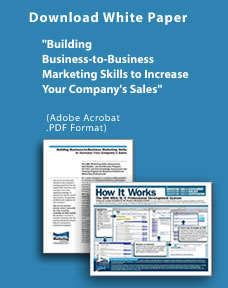
Test, Train, and Build Your B2B Marketing Skills for Better Sales Success: BMA Announces New Assessment, Training, and Certification for B2B Marketing Managers
For more information on the new BMA Marketing Skills Assessment, Skill Building and Certification (MSA/B/C) training and professional development program, visit http://www.businessmarketinginstitute.com