











Tuesday Marketing Notes (Number 70 —February 20th, 2007)
A B2B Marketing Newsletter for BMA Members
____________________________________________________________
MAKE SURE YOU CONTINUE TO RECEIVE EACH ISSUE OF TUESDAY MARKETING NOTES—CLICK HERE TO RENEW YOUR FREE SUBSCRIPTION
(NOTE: if you’ve already signed up previously at this link above, no need to do so again)
INDEX TO PAST ISSUES OF TUESDAY MARKETING NOTES:
Click here

Special Savings Promotion for BMA Members—Click here
–––––––––––––––––––––––––––––––––––––––––––––––––––––––
Targeting a New Market (Part 5: The Four Principles for Launching Your New Marketing Program on the Internet)
by Eric Gagnon
Last week, we discussed the first key principle for executing Internet marketing programs: Making it easy for interested potential prospects to find your company. This week, we’ll pick up where we left off, covering steps for executing Internet-based marketing programs for your launch in a new market.
2.) Explain to Your Web Viewer How Your Product Solves their Business Problem
Once users hit your Web site, as a result of your Google AdWords text ad, or through their own keyword searches, these busy information seekers want to know two things: What product you’re selling, and what your product can do for them.
Specifically, these users want to know how your product solves their business problem. But a clear, compelling presentation of this problem and solution isn’t enough: Your problem must reach a threshold that is high enough to make buying your product worth the effort and expense to the user. This problem must be felt acutely enough by your user to motivate them buy your solution. If your user isn’t experiencing the problem you’re describing, or if this problem isn’t important enough in the scope of the potential prospect’s work or business process for them to solve by purchasing your product, you’re either presenting the wrong problem and solution, or the market isn’t going to buy your product.
Speed of presentation is also critical: If your Web page doesn’t communicate this information quickly enough to your site visitor, they will lose interest and move on. According to Web viewer studies, the average Web user spends well under sixty seconds reading the average Web page, but as marketers, we have to assume we get far less time to hold our viewers—I’m betting less than ten seconds.
So, assuming this is true, your best chance of keeping a site visitor on your page is to front-load the main Web page you’re dedicating to your new market with a big, bold statement describing how your product’s strongest benefit solves the prospect’s problem in their market, combined with a nice big product shot (or an infographic, if you’re selling services).
One of the ways to do this is to use a headline/subhead combination in your dedicated home page (or keyword search landing page) that addresses the specific needs of a prospect in your new market, and which describes your product, what it does, and what problems it solves. Here’s an example for a company offering Web-based on-demand software applications to IT managers in small to mid-sized companies:
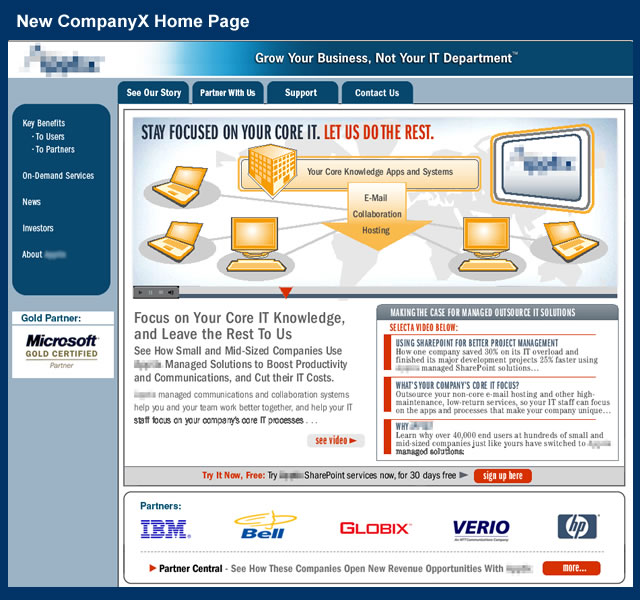
The more specialized, the better: If you’re addressing your product to the needs of a specific new market, then focusing your presentation on the prime benefit that sells your product to this new market, and driving prospects to this page from your print ads, mailings, and online marketing efforts moves these prospects closer to making their decision to contact your company.
This is the opposite of what most companies in B2B do—they tend to fill their site’s main page with marketingspeak and over-generalized information that actually gets in the way of communicating essential product details to busy, short-attention span Web viewers. Hit hard on the problem solved that is important to your viewer using plain language, and let your branding be established by the outstanding way you treat prospects as they become customers, before and after the sale.
Web Video: The Most Effective Way to Sell Your Product Online
A short video presentation, with a spoken audio soundtrack, is the most effective way to present, explain, and sell your product online, yet it’s surprising how many companies in B2B still aren’t using video as an integral element of their Web sites.
Trade show videos make excellent Web videos: If you’ve already produced a short sales video for your trade show booth (as described in TMN 68 on 02/06/07 at this link), these videos make excellent Web videos, and they can be moved to the Web with little or no modification. Best of all, since they’re short and concise, trade show videos work in the same way online to make a polished presentation on your product as they do in your trade show booth.
Focus on the audio narration: Remember the most important part of any video, including Web videos, isn’t what you see, but what you hear, so focus your efforts on writing a professional, compelling script and having the script voiced by a professional announcer.
You don’t need (or want) spinning logos, animation, or other fancy special effects for your Web video. You can produce a very effective Web video with no more than a basic PowerPoint-type slide show and some high-quality product shots, so long as your spoken audio effectively presents and sells your product.
3.) Give Site Visitors all the Information They Need to Answer Their Most Likely Questions on Your Product
As a marketing professional, you represent your company’s prospects and customers: Fast, clear, effective product presentation are critical elements of any Web page. As a marketing professional working on Web projects, you also serve as a stand-in and advocate for your potential prospects who must readily understand the copy used on your Web site, and the interface you’re using to make it easy for your site users to move closer to buying your product.
Learn to look with “new eyes:” To serve this role, you must develop the ability to view the Web pages you specify and produce with “new eyes;” that is, as these prospects would see them. Do this by trying to blank out your memory about your product, and then taking a quick look at your Web page: If your product, its main benefit, and other key information on the page are instantly clear and understandable to you, without any information gaps, then you’re on the right track.
Learning to view every Web project with “new eyes” means looking at your product as a total stranger would, and readily answering all of the questions they’d ask. It also means starting the process of supplying your site visitors with all the information they’ll need to make to make their decision to buy from your company, and not your competitor.
Answer the most likely questions: Frequently-asked question (FAQ) files go back to the earliest days of the Internet, and they’re commonplace on most B2B Web sites, because they meet the need we described earlier for Web users to get “just the facts” on products they’re researching. You can also use answers in your FAQ to neutralize the most common objections raised to your product.
When launching into a new market with your product, you might not know the questions prospects in this market will be asking, but can you can do a respectable job of anticipating these questions, so start there and combine this material with the questions your current prospects are already asking, to create a workable FAQ file.
White papers and case studies: White papers, whose content ranges from selling-oriented formats that describe your product, its applications, features and benefits without the usual marketing hype found in most glossy product brochures, to technical briefs on specialized issues or applications, add depth to your product story, and speed up the selling process by answering your site visitor’s technical questions. Case studies documenting how your product solves real-world problems for actual customers are another important confidence-booster for site visitors, and they add tremendous credibility to your product’s story by helping to answer your interested prospects’ most common technical and application questions.
You can place all of these informational elements in a sidebar on every page of your site, using one- or two-line text summaries with links to other parts of your site. If you make it easier for site visitors to answer the questions they have on your product on their own, you make it easier for your sales reps to move past these issues when they engage these prospects by phone or in person.
Testimonials: Every potential buyer always feels more comfortable knowing that your current customers are pleased with your product, and linking testimonials and pull-quotes on your Web page from satisfied customers reassures your potential prospects that they won’t make a bad decision if they buy from your company.
4.) Establish an Ongoing Communications Channel to Open a Continuous Dialogue With Your Prospect
The most important goal of your Internet marketing effort is to establish an ongoing communications dialogue to start the process of turning your site visitor into a prospect, and your prospect into a buyer.
As we all know, many prospects in sales situations aren’t ready to buy right away. They have infinite reasons, both real and imagined, for deferring or delaying their final purchase decision: Because the prospect doesn’t have the money in their budget this quarter, or they need to bring others around in their company who must also approve the purchase, or your rep must work with the prospect, over time, to achieve “buy in” for your product, it could be several months, or even a year or more, before the first sale is made.
Here, your role as a marketing professional must go beyond merely throwing the new leads you’ve helped to generate over the cubicle wall, to working with your company’s sales team to open a continuous communications channel with their prospects.
Opening the channel: Here are some techniques you can use in your Internet marketing program to open this channel with their prospects, and to help your sales reps keep this dialogue going:
• To start, offer site visitors access to information that’s valuable to them about your product or their industry: An opt-in e-mail newsletter, a free industry study or research report of interest, a comparison chart detailing your product’s features vs. your competitors, or any other type of helpful information you can send to a site visitor on a regular basis establishes this communications channel, provides ongoing opportunities to provide other relevant and useful information to prospects, and always opens an opportunity for a prospect to contact your rep, or for your sales team to follow-up with the prospect;
• In addition to supplying this steady flow of generalized online information to prospects, once you establish this dialogue with prospects you can supply your sales team with a steady flow of relevant news articles, studies, and other pertinent information that they can share with their individual prospects, according to the prospect’s individual needs.
For example, a relevant, specific news article discussing a key issue that’s important to the industry gives your sales reps a reason to contact your prospect.A sales rep who periodically calls a prospect to share the latest news of an industry research or technical study is more welcome than the usual calls prospects receive from sales reps who are just checking in to ask if the prospect is ready to buy. This only irritates the prospect because they feel they’re being pressured. Smart companies use this consultative approach to keep their reps in front of prospects, and smart reps know this technique puts them inside the prospect’s decision process.
More Web Development Resources
Here are some additional links you may find useful in your Web marketing and development projects:
Google Keyword Suggester: This handy and interesting Google utility provides suggested, related alternatives to keyword phrases as you enter them, along with the search results reported for each phrase;
Weblogs, Schmeblogs: What Sells Your Product on the Internet—and What Doesn’t;
Web Site Self-Defense for Marketing Managers: How to Make the Guy With the Pony Tail Work for You, Instead of You Working For Him;
The Web Video Revolution: Making the Most of Web Multimedia for Your B2B Web Site
Next week, we’ll cover best methods for introducing print advertising into your marketing program for your new market launch . . .
Comments? Questions? Send them to me at: eric@realmarkets.net
___________________________________________________________
Attention Marketing Managers:
Get a Second Opinion on Your Marketing Program. . . FREE
Think you should be spending less and getting more from your current marketing program? Tired of hearing empty “branding” promises from your ad agency that never seem to translate to actual, measurable sales results?
Or, have you been losing out on important new selling opportunities due to poor execution in your marketing projects?
Let us give you a second opinion on your current B2B marketing program and deliverables, at no cost or further obligation.
For more information, contact us at: ericgagnon@verizon.net or click on this link below:

_____________________________________________________________
Eric Gagnon (eric@realmarkets.net), is president of GAA (www.realmarkets.net), a sales and business development consulting firm, and is the author of The Marketing Manager’s Handbook, the master study guide for the Business Marketing Association’s Marketing Skills Assessment, Skill Builder, and Certification (MSA/B/C) programs.
For more information on The Marketing Manager’s Handbook, available to BMA members at a special discount, link to:
http://www.businessmarketinginstitute.com/book.html
_____________________________________________________________
Test, Train, and Build Your B2B Marketing Skills for Better Sales Success: BMA Announces New Assessment, Training, and Certification for B2B Marketing Managers
For more information on the new BMA Marketing Skills Assessment, Skill Building and Certification (MSA/B/C) training and professional development program, visit http://www.businessmarketinginstitute.com