











Tuesday Marketing Notes (Number 58—November 14th , 2006)
A B2B Marketing Newsletter for BMA Members
____________________________________________________________
MAKE SURE YOU CONTINUE TO RECEIVE EACH ISSUE OF TUESDAY MARKETING NOTES—CLICK HERE TO RENEW YOUR FREE SUBSCRIPTION
(NOTE: if you’ve already signed up previously at this link above, no need to do so again)
INDEX TO PAST ISSUES OF TUESDAY MARKETING NOTES:
Click here
Special Savings Promotion for BMA Members—Click here
–––––––––––––––––––––––––––––––––––––––––––––––––––––––
How to Write a Great Sales Letter (Part 1: Finding Your Tone and Writing Your Lead)
In all its forms, the sales letter is the most basic and the most personal form of marketing deliverable. Sales letters are in important element of many marketing projects:
Direct mail packages: Sales letters appear alongside brochures, catalog sheets, order forms, and other pieces in direct mail packages for customer promotional mailings, repeat mailings to prospect lists, and mailings to rented lists;
Sales Kits: Chances are, as a marketer you’ll be asked to write model letters used as sales letters by your company’s sales team in sales kits and other presentation materials—inquiry follow-up letters, post-presentation follow-up letters, and other letters to cover the daily prospect and customer-contact scenarios that are part of your product’s sales cycle;
High-level business development: Ghost-writing letters for executives in your company, addressed to senior executives in other companies, to open discussions for joint business development activities, co-marketing, and other “big deals;”
E-Mail and the Internet: Modified for the new marketing medium of e-mail, sales letter copywriting skills are also very important for e-mail applications. Even though they’re much shorter than conventional printed sales letters, you still must write e-mail notes that identify with your readers and motivate them to take the next step closer to buying your company’s product.
Whether it’s a sales letter for a mailing piece sent to thousands of prospects, a short e-mail follow-up response note to a prospect inquiry, or a highly personalized letter written for an audience of one for your biggest sale of the year, what all sales letters have in common is they establish a personal connection with your reader, using words alone to motivate them to link your company’s Web site, call your company or one of your sales reps, redeem the special offer, or make the first order.
When used in combination with other marketing deliverables in mailings and sales kits, the sales letter ties togetherthe polished presentation and imagery of your company’s brochure, the technical precision of your product specsheet, and the hard persuasion of your order reply card with a personal appeal that tells your product’s story. Your sales letter is the personal contact between you and your reader that puts your company, product, and offer in perspective.
Every marketer should know how to write a sales letter for their company’s product, even if they’re not the ones who will be writing the sales letters used in their marketing programs. For marketing managers, writing a sales letter helps you develop the discipline of telling your product’s story, putting down on paper just what your product does and how it works, and communicating your product’s most compelling sales benefits, and why these benefits are important to your reader.
The process of writing a sales letter also forces you to do the hard work of learning and knowing your reader’s motivations, and giving voice to the motivating benefits that, with further rewriting, can be used in copy for brochures, flyers, ads, and your Web site.
Even if your agency’s copywriter is the one who’s writing the final deliverable, all marketing projects move faster and better if you can hand over a sales copy outline to your agency, and a basic sales letter is one of the best and most effective forms of a sales copy outline.
Sales Letter Structure
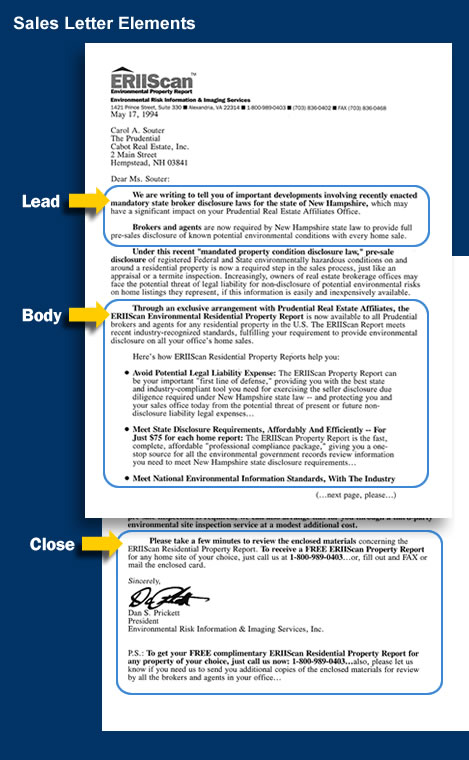
Regardless of their length or application, sales letters share the following general structure:
Lead: Presents your product’s main benefit to the reader, and gives them a reason to read the rest of your letter—or, tells them just enough about your product so that “something sticks,” even if they don’t read your entire letter;
Body: Answers the most common questions your reader would ask about your product. Makes the most important details easy to read, since most of your readers will only skim-read your letters anyway;
Close: As important as the lead, the close tells your reader what they get if they act now, and what you want them to do next.
When writing a sales letter, you can’t lose if you follow the seven steps outlined by legendary direct mail copywriter Bob Stone:
- Promise a benefit in your headline or first paragraph—your most important benefit;
- Immediately enlarge upon your most important benefit;
- Tell the reader specifically what he/she is going to get;
- Back up your statements with proof and endorsements;
- Tell the reader what he might lose if he doesn’t act;
- Rephrase your prominent benefits in your closing offer;
- Incite action—now.
Sales Letter Soup Starters
This week, we’ll focus on the lead paragraph, and next week, we’ll cover some of the important aspects of the body copy and the close of your sales letters.
The general letter-writing techniques covered here will also help you create a solid working sales copy outline of the essential sales benefits and content to pass along to your ad agency or marketing consultant, if they’re the ones who are writing your company’s sales letters.
Let’s start with some ideas you can use to start writing the lead paragraph of your sales letter . . .
How to Begin: Start Writing and Keep Writing
The first step in writing a sales letter, or writing anything, is to write. Don’t spend time organizing, outlining, or overthinking. Just start writing, and keep writing. Stay bolted to that chair, and keep writing some more. Eventually, your thoughts will organize themselves and the good stuff will come out. Just keep writing.
Step 1: Writing the Sales Letter Lead
Like the headline of an ad, the first paragraph of any sales letter, or the lead, is its most important part, since your reader makes their decision whether or not to read the rest of the letter based on what you tell them in your lead.
Lead With Empathy
Empathy is the most important characteristic of any sales letter: A clear expression that you identify with your reader, and you understand and share an appreciation for:
• Your reader’s problem;
• Your reader’s situation;
• Your reader’s likes and dislikes
If you’re a dedicated marketer in the same field as the readers you’re writing for, you probably know, share, and appreciate the problems and concerns of your prospects, as they relate to the problems that can be solved by your company’s product.
Pose the problem you and your reader share, and then begin to build your case for how your product solves your reader’s problem. Here are some examples:
“ If you’re concerned about the effect of rising energy costs on your company’s shipping expense—and who isn’t these days—then you can’t afford not to take a closer look at . . .”
“ We know the last thing you need on your production shift is downtime in your warehouse control system. That’s why . . . ”
“ You already know that failures in critical valve assemblies are the most common cause of hydraulic system failures in high-temperature or other demanding environments. We bet you didn’t know that now you can stop these failures once and for all—guaranteed.”
“ Like all business owners, we know you’re fighting the high—and rising—costs of health care coverage for your employees . . . “
Ask a Question
Another powerful way to lead a sales letter is to ask a question that has a way of engaging your reader and involving them in your product’s story:
“Did you know that 85% of recently-surveyed IT executives in the trucking field lose about 12 hours each week duplicating their intermodal transport requests? Our clients spend just one hour each week, and save half their multi-route shipment processing costs with . . . ”
“Would you like to create a new profit center for your newspaper’s print and online classified advertising business?”
“Can you meet next year’s tougher ASTM E18 Rockwell Standards on your heat-treated steel products?”
Start it Straight
Sometimes, a straightforward announcement or statement about your product is the best way to open your sales letter:
“As an independent audio-visual professional, we’d like to tell you about a new profit center opportunity that gives you the ability to draw repeat income from A/V installations with your current accounts and venues . . . ”
“We’re pleased to announce a 20% discount for this month only on our entire line of popular K70 emulsion products for opthalmic applications.”
“As requested, enclosed is your developer’s reference and information kit . . .”
Break the News or Cite a Source
News announcements or new research, such as industry studies or key statistics that are important to your reader, make great leads for sales letters:
“According to a recent study by the Production Energy Initiative, over 55% of all plant operations lack peak energy monitoring features on their energy control systems, even though these features can save plant managers up to 15% on their annual energy costs.”
“We’re pleased to announce our Duroform is one of the first companies in our industry to meet the new ASTM standards for Adhered Manufactured Stone and Veneer. What does this mean to you?”
“Citing lower product defect rates and less finishing time, new results from a survey conducted by the American Metal Coatings Institute show a 38% increase in installations for gas plasma bonding systems for the precision machining industry”
Build a mailing around a news article and survey result: In addition to being powerful sales letter leads, news announcements or survey results favorable to your company can provide a rationale for sending a mailing to your prospects and customers, with a mailing built entirely around the announcement.
Sometimes, a Headline Works Just Fine
For sales letters that are less personalized, like those used in very large mailings, you can use a leading headline, or even a paragraph (also called a “Johnson Box”) set bold, or in a box above your salutation of your sales letter to communicate the gist of your product, and your offer, before leading into your copy:
“End those wireless reception ‘dead spots’ for your warehousing data management system, and get the only 100% uptime guarantee available —from us.”
“Over 44,000 items in stock for immediate delivery, for all your precision milling and machining needs—Call us today at 888-555-1234 to reserve your 20% discount on your first order with us . . . ”
Start With a Strong Lead, and Follow Through With Supporting Benefits
Because it grabs hold of your reader and brings them into the rest of your letter’s body copy, the lead paragraph (or headline) is the most important part of your sales letter.Strong leads also make the rest of the writing process go easier and faster, since they often establish a theme from which all of the other key benefits you’re writing about will follow.
Develop a great opening, and you’re well on your way to the next step, which is to tell your product’s story, to get all of the most important details on your product’s benefits down on paper. Then, as you edit, eliminate, and rewrite, you’ll refine your letter down to its best clarity, purpose, and length.
Next week, in Part 2 we’ll cover the rest of the process of writing effective sales letters, with some ideas on how to tell your product’s story in body copy, effective sales letter closes, and writing and layout techiques for busy skim readers . . .
Comments? Questions? Send them to me at: eric@realmarkets.net
___________________________________________________________
Attention Marketing Managers:
Get a Second Opinion on Your Marketing Program. . . FREE
Think you should be spending less and getting more from your current marketing program? Tired of hearing empty “branding” promises from your ad agency that never seem to translate to actual, measurable sales results?
Or, have you been losing out on important new selling opportunities due to poor execution in your marketing projects?
Let us give you a second opinion on your current B2B marketing program and deliverables, at no cost or further obligation.
For more information, contact us at: ericgagnon@verizon.net or click on this link below:

_____________________________________________________________
Eric Gagnon (eric@realmarkets.net), is president of GAA (www.realmarkets.net), a sales and business development consulting firm, and is the author of The Marketing Manager’s Handbook, the master study guide for the Business Marketing Association’s Marketing Skills Assessment, Skill Builder, and Certification (MSA/B/C) programs.
For more information on The Marketing Manager’s Handbook, available to BMA members at a special discount, link to:
http://www.businessmarketinginstitute.com/book.html
_____________________________________________________________
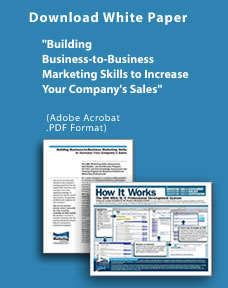
Test, Train, and Build Your B2B Marketing Skills for Better Sales Success: BMA Announces New Assessment, Training, and Certification for B2B Marketing Managers
For more information on the new BMA Marketing Skills Assessment, Skill Building and Certification (MSA/B/C) training and professional development program, visit http://www.businessmarketinginstitute.com