











Tuesday Marketing Notes (Number 55—October 17th , 2006)
A B2B Marketing Newsletter for BMA Members
____________________________________________________________
MAKE SURE YOU CONTINUE TO RECEIVE EACH ISSUE OF TUESDAY MARKETING NOTES—CLICK HERE TO RENEW YOUR FREE SUBSCRIPTION
(NOTE: if you’ve already signed up previously at this link above, no need to do so again)
INDEX TO PAST ISSUES OF TUESDAY MARKETING NOTES:
Click here

Special Savings Promotion for BMA Members—Click here
–––––––––––––––––––––––––––––––––––––––––––––––––––––––
Ending the Sales/Marketing Disconnect: Nine Ways to Be a More Effective Marketing Manager (Part 1)
by Eric Gagnon
In the past four years I’ve noticed a trend away from treating B2B marketing the same as consumer-oriented marketing, and a greater emphasis in companies for accountability in B2B marketing programs—both very good things.
One of the ways this trend expresses itself is in the perceived need for better measurement of marketing programs. In my opinion, the quest for better measurement only masks the real elephant in the room, the “sales/marketing disconnect,” a major issue in our field.
The sales/marketing disconnect is real, and it exists wherever a company’s sales team thinks the company’s marketing program isn’t relevant to their day-to-day work in the field selling the company’s products, or when the company’s Sales VP thinks the company’s marketing program isn’t generating sales leads for the sales team. If it’s a contest between a sales team that’s bringing in the business and a marketing department that’s off in the clouds chasing brand awareness, and designing pretty Web sites that don’t generate sales leads, then it’s no contest—marketing loses every time.
This week and next, we’ll hit some of the important values that will help you get ahead and stay ahead in your marketing career, whether you’re a marketing manager running marketing programs for your company, or your on the agency or consulting side working with your clients.
These principles help you close the sales/marketing disconnect by keeping you focused on what’s important: Day-to-day execution of critical marketing projects, clear presentation in every marketing deliverable, and generating sales response—sales leads and inquiries—for your company.
Ranked by their order or importance, here are the nine . . .
9. Learn How a Thing is Done, Even if You’re Not the One Doing It
Mastery of the core skills every marketing professional should know—what I call the tradecraft of marketing—separates the effective marketer from the idle dreamer. However, while mastery of skills is important, knowledge of the process of marketing execution that goes beyond your responsibility in many marketing projects can also be as important a factor in helping you execute your marketing projects well, and on time.
For example, as a marketing manager, agency rep, or marketing consultant it’s highly unlikely you’ll be running a printing press, or running operations at your lettershop for your direct mail project, and it’s somewhat less likely you’ll always be writing copy for your ad layouts, or that you’ll be designing your own brochures. However, you must try to learn as much as possible about these steps, and about every step in the execution of all the different marketing projects you’ll be working on as a marketing professional, for each and every marketing project—even if you’re not responsible for that step.
Learning how a thing is done, from step “A” through step “Z,” helps you prevent delays in executing marketing projects. For example, knowing that every printed piece requres at least 3/8” white space at the bottom of a layout to allow it to be fed through a printing press without ink all over your layout can save you a day’s delay spent re-doing this layout on a major printing project. Knowing how many mailing pieces your lettershop can process per hour helps you set realistic schedules for large, important mailings. These critical steps in marketing execution are usually not the responsibility of marketing managers, but knowledge of these steps by marketers is necessary to insure competent execution.
Learning and knowing as much as you can about the A-to-Z steps of marketing execution for every marketing project keeps your program on track, and prevents every marketing project from becoming an 11th-hour fire drill with your marketing team—your ad agency, printer, Web developer, lettershop, other outside consultants, or vendors.
This knowledge breeds respect for the process in you as a marketing professional, and, when practiced, will earn you the respect of the other members of your marketing team.
And if you’re on the agency side, where you are more involved in this day-to-day execution, educating your clients as much as possible on these essential steps, by opening up your process and sharing what you know with your client’s marketing managers helps your projects run more smoothly.
8. You Can’t Lose If You Follow the Old Masters
The modern advertising and marketing field was basically invented by three men, starting from about 100 years ago:
Claude Hopkins, head of early ad agency Lord & Thomas since 1907, and who wrote Scientific Advertising in 1923, is regarded as the father of modern advertising, having invented or popularized many of the standard practices of advertising today: Testing, sampling, free offer promotions, and “reason why” ad copy;
John Caples, creative head of BBDO, and arguably the best advertising copywriter of all time, wrote Tested Advertising Methods, published in 1932. Caples, who wrote many of the most successful print ads ever produced, was a master at writing headlines, body copy, and offers that tapped into the universal human motivations of his readers;
Rosser Reeves, Chairman of Ted Bates & Co., and author of Reality in Advertising, created the concept of the “Unique Selling Proposition,” (USP) a technique of using the unique benefits and features of a product to position it effectively in a company’s advertising, and utilized the USP in some of the most effective TV commercials of the 1950s, including the famous Anacin commercials (search YouTube.com for “anacin commercial” to view this spot).
Buy, read, and study the three books mentioned above, and grab hold of as many copies of the ads written or produced by Hopkins, Caples, and Reeves. Study the persuasive arguments they use in their copy, and the logic of their presentation as they walk readers (and in Reeves’ case, TV viewers) through the reasons why they should buy the product.
Why, you ask, should you care at all to study ads written back when Truman was president, and before? Some of the highest-growth areas of marketing today (and some of the best marketing and selling opportunities in new media) are in new advertising formats such as Google AdWords-type keyword search marketing programs. I know for a fact that the top copywriters working in this area are using the copywriting techniques detailed by John Caples in Tested Advertising Methods to write their Google AdWords text ads and landing pages.
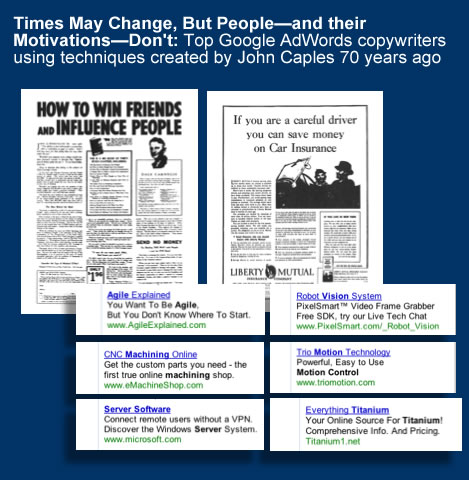
While times may change, people, and their motivations, don’t. This is true regardless of the industry you’re working in—whether you’re writing a quick sales copy outline for your agency’s copywriter, some benefit bullet points for copy on your company’s Web site, or a script for a sales video.
No matter the industry, all of your potential prospects are driven by the same basic motivations: They want to make more money, save more money, be more productive, more efficient, spend less time doing non-productive things, and get ahead of their competitors.
When used in your ad copy and other marketing deliverables, these basic appeals to human motivations are the most effective way to move your readers closer to the next step in your selling process.
7. Your Job is to Generate Sales Response for Your Company’s Sales Team
The status of marketing as a profession declined around the time of the first dot-com bubble of the mid 90s, as marketers began to drink the bathwater that started to be written about marketing: That massive “branding” campaigns alone could build new companies in the “new economic paradigm” of the dot-com boom. That story ended with multi-million dollar ad buys for sock puppets promoting unknown Web companies that were out of business in a year.
Inside the real companies of our world, the marketing department isn’t some kind of creative boutique that exists to burnish a company’s brand image. In B2B, marketing exists in a company today for the same reason it always has—to generate sales response in the form of sales leads and inquiries, and to get out ahead of the company’s sales team to crack open new markets and business opportunities.
In B2B marketing, your job as a marketer has two key parts:
• First, and most important, to support your company’s sales team by generating sales response—inquiries and leads—from your marketing program;
• Additionally, to run ahead of your marketing program to seek new markets and business development opportunities for your company, through new product launches, new market tests, and joint business ventures, which are all supported by your marketing program
The first step in developing marketing programs that generate sales response is clear, effective presentation of your product’s most compelling benefits, and the first step in achieving clear presentation is good listening.
Listen—carefully—to the most effective ways your company’s sales reps present and sell your company’s products, and incorporate the best of this into your ads, mailings, and deliverables. This clear, salesmanlike presentation, when used in your copy and layout for all marketing projects, and combined with strong offers and a call to action that tells the reader:
- What you’re selling
- What’s so good about that?
- Why they need it
- What they need to do next to buy it
— goes a long way to making your ads generate sales response instead of the weak memory called “branding,” a word that people who write about marketing like to use a lot, but which doesn’t make the phone ring or generate e-mail response.
There are plenty of marketers who got marginalized in their companies because they wasted their company’s money chasing brand awareness, instead of getting on the ball with their marketing program to generate sales response for the company’s sales reps.
Be the one who can crack the code of what it takes to sell your company’s product, meet your deadlines on those projects, and make sure these projects use content that’s clear, powerful, and persuasive enough to drive sales leads to your company’s sales team, and you’ll be indispensible in good times and bad.
6. Always Measure, But Don’t Be Afraid to Admit What Can’t Be Measured
For awhile there, everyone was talking about “marketing measurement” and related topics like “metrics,” and my favorite, “creating the marketing dashboard.” All of which sounded a lot to me like trying to attain the same level of perfection in measurability for marketing programs that can be achieved in other areas, like inventory control, production scheduling, or accounting. This is a fool’s quest, as I’ll soon explain.
The reality is that most companies who think they have a measurement problem don’t have a measurement problem, they have an inadequate sales response problem—i.e., their ads, mailings, and other marketing efforts aren’t generating enough leads for their sales people. In these cases, better or more precise measurement would only be a better and more precise way of measuring what there’s not enough of—sales response.
In companies running clear, powerful, and persuasive marketing programs that generate plenty of sales response (i.e., leads), the company’s Sales VP or CEO isn’t worried about measurement, because measurement follows clear presentation: Ads using powerful, benefit-oriented headlines and copy, with clear “calls to action” that offer compelling promotions to drive readers to the first step in the sales cycle promote effective measurement of marketing programs. When readers respond to these calls to action, the results can be easily measured, usually with a tally sheet for each ad or Web landing page.
While clear presentation helps you create more measurable marketing programs, there will always be parts of your marketing program you won’t be able to measure.It’s a mistake to believe that all results from every marketing program can be measured from some kind of super-exact “marketing dashboard,” when the fact is, they can’t.
For example, it’s difficult to measure total response from print advertising, even when using trackable URLs, order phone numbers, or key-coded ads. Prospects don’t remember where they heard about your product, or they don’t care enough to remember which ad they saw, or where they saw it. They will see your ad this week, forget about it, then call your company six months from now. This also happens to a lesser extent with direct mail and other marketing activities.
Do your best to count inquiries, leads, and (if you can) sales from your ads, mailings, and other activities, and calculate your cost-per-lead figures for these activities.
Then, combine these numbers with your calculation of the lifetime value of each customer to your company. This measurement tells you how your marketing costs stack up against the big picture of the lifetime sales from each new customer acquired, and is more of a true reflection of your company’s marketing investment than the fool’s errand of trying to measure one-shot ROI on every ad or mailing.
While it’s likely you still won’t receive a 100% accurate measurement of these activities, you will instill in your marketing program the discipline of accountability, which is a good thing. More importantly, you’ll be generating more than enough sales leads to make the issue of exact measurability a moot point.
Next week, we’ll cover five more ways to be a more effective marketer by closing the sales/marketing disconnect . . .
Special Thanks: I had the pleasure of presenting on this topic during last week’s meeting of the BMA’s New Jersey Chapter at Fairleigh Dickinson University in Madison, NJ. I’d like to thank Fern Dickey, president of the BMA-NJ chapter, and Melissa Fisher, for inviting me to speak, and Kendra von Achen and Tom Lento, past BMA-NJ chapter president, for their kind hosting and support. Thanks also to Christina Genest, our host from FDU, for her help with putting together this memorable event at FDU’s stately Lenfell Hall at “The Mansion.”
Comments? Questions? Send them to me at: eric@realmarkets.net
___________________________________________________________
Attention Marketing Managers:
Get a Second Opinion on Your Marketing Program. . . FREE
Think you should be spending less and getting more from your current marketing program? Tired of hearing empty “branding” promises from your ad agency that never seem to translate to actual, measurable sales results?
Or, have you been losing out on important new selling opportunities due to poor execution in your marketing projects?
Let us give you a second opinion on your current B2B marketing program and deliverables, at no cost or further obligation.
For more information, contact us at: ericgagnon@verizon.net or click on this link below:

_____________________________________________________________
Eric Gagnon (eric@realmarkets.net), is president of GAA (www.realmarkets.net), a sales and business development consulting firm, and is the author of The Marketing Manager’s Handbook, the master study guide for the Business Marketing Association’s Marketing Skills Assessment, Skill Builder, and Certification (MSA/B/C) programs.
For more information on The Marketing Manager’s Handbook, available to BMA members at a special discount, link to:
http://www.businessmarketinginstitute.com/book.html
_____________________________________________________________
Test, Train, and Build Your B2B Marketing Skills for Better Sales Success: BMA Announces New Assessment, Training, and Certification for B2B Marketing Managers
For more information on the new BMA Marketing Skills Assessment, Skill Building and Certification (MSA/B/C) training and professional development program, visit http://www.businessmarketinginstitute.com