











Tuesday Marketing Notes (Number 2—October 4th, 2005)
A B2B Marketing Newsletter for BMA Members
____________________________________________________________
MAKE SURE YOU CONTINUE TO RECEIVE EACH ISSUE OF TUESDAY MARKETING NOTES—CLICK HERE TO RENEW YOUR FREE SUBSCRIPTION
(NOTE: if you’ve already signed up previously at this link above, no need to do so again)
Special Savings Promotion for BMA Members—Click here
–––––––––––––––––––––––––––––––––––––––––––––––––––––––
Clear Presentation: What You Say Is More Important Than How You Say It
by Eric Gagnon
Next to fast, effective marketing execution, the most important goal of your marketing program is to insure that every ad, mailing, product brochure, Web site, or any other marketing piece delivers clear presentation.
By this I mean the clear and obvious presentation of your product’s most compelling sales benefits, answering these questions for your prospect:
What is your product?
What does your product do?
What’s in it for me?
The most important content of any ad, mailing, Web page, or other marketing deliverable answers the most likely questions your prospects would ask about your product, and gives these prospects the reasons they should buy it.
And doing this plainly, simply, and clearly, to get over your prospect’s short attention span and through the fog of all the other marketing messages they face every day, is the goal of clear presentation.
Let’s face it: In the B2B world, your prospects are just too busy to figure out cute headlines, or to “get” some clever new “branding” message.
So why not give your prospects what they want: The plain facts about your product, presented in a way that motivates them to take one step closer to buying your product?
Plainly-Stated Benefits Turn Readers into Prospects
Clear presentation starts with using plainly-stated benefits that respond to the basic needs of your prospects in your market.
Here’s a simple example—look at these two headlines below:

Which headline is more effective? If you picked the one on the right (like everyone does), you’re responding to a clear sales benefit that’s compelling to everyone’s need to save money and cut costs.
Times May Change—But People, and their Motivations, Don’t
What we’re talking about is a return to salesmanship—expressed in plain language that’s easily understood by busy prospects—in your ads, mailings, and other marketing deliverables.
Claude Hopkins, the father of modern advertising, once defined advertising as “salesmanship in print,” and this approach was widely practiced by John Caples, Rosser Reeves, and the other classical masters of ad copywriting in the 1930s, 40s, and 50s.
If you flip through any magazine from the 1930s, 40s, or 50s, you’ll see that most of the advertising of this time used plainly-worded sales benefits in headlines that addressed basic human needs and wants, with body copy that provided the essential facts readers needed to know about the product.
Take a look at the ads in these old magazines and what you won’t find are irrelevant, overdesigned ad layouts, Eurotrash graphics, amnesia-inducing headlines, and the other hallmarks of miss-the-point presentation seen in today’s advertising.
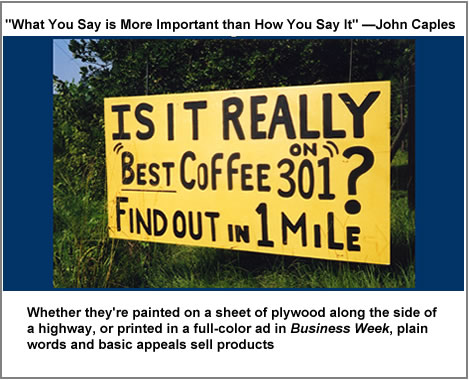
Classic, Sales-Oriented Copywriting is More Relevant than Ever
By now, you’re probably asking yourself: “What does any of this have to do with the way marketing is done in the here and now?”
Well, the hottest ticket in marketing today are Google AdWords-type keyword and search engine marketing programs, where advertisers write short, text-only ads designed to draw clicks from targeted keyword searches relating to specialized products.
And just where do you think the top copywriters who write these tight, compelling, must-sell-it headlines and one-line copy tags go when they need copywriting ideas and advice?
I happen to know that most of them have read, studied, and copied the techniques taught by John Caples in his ad copywriting bookswritten over 50 years ago!
Fact is, all prospects who “google” for specialized B2B products and services really want to do is solve basic human business problems: To save money, to get ahead, to be more efficient or productive—and to find this in a product or service that makes their life on the job easier, better, and more successful.
AdWords ads featuring headlines and text that present clear and compelling benefits that give these prospects what they want will be clicked; ads without these benefits won’t.
Google AdWords (and other) keyword advertising programs live and die by this powerful, clear, effective presentation. The only thing that counts is a tangible, sales-oriented result: The number of click-throughs from the ad to the targeted landing page link on your site, which begins the selling process for your product. Within a few hours, click-throughs from an AdWords program tell you whether one headline pulled better than another, compared to days or weeks spent waiting for results from mailings or ad placements.
Do the guys who write successful Google AdWords ads know something that can be applied to print and all other types of advertising? And did they learn it from studying the classical copywriting masters of the past? You bet!
(By the way, do yourself a great big favor and get a copy of Tested Advertising Methods, or any other book written by John Caples, and internalize his copywriting and sales motivation techniques—this way, you’ll train yourself to recognize effective, sales-oriented copy when you see it, even if you never write a word of it yourself.)
Plain Words and Basic Appeals Sell Products
The fact is, plain, benefits-oriented sales copy and clear layout techniques are effective in any advertising medium. Your prospects are busier than ever, and their attention spans are shorter than ever—so why not give your marketing efforts the best chance for success, by using clear presentation every time you advertise your product in your market?
How and Where to Find Your Product’s Best Sales Benefits
Where do you discover your product’s most compelling sales benefits for use in ad copy for your marketing projects? If you’re working in an established company, your company’s sales reps are your best source of copy ideas.
To discover good sales benefits, be a good listener: Listen to your sales reps deliver their sales presentations, and ask for their most persuasive and effective sales arguments.
If these benefits and product feature descriptions are successful in closing sales with prospects face to face, with some rewriting they’ll also work in sales copy for your ads, mailings, and other marketing deliverables.
If you’re working in a start-up, or with a new product launch with an untested market, persuasive sales benefits can be discovered when you play the role of salesman, by making presentations to potential prospects in your market, and listening to what they tell you.
Salesmanship—learning to talk about your product, and learning how to persuade prospects to buy it—is a necessary skill for every marketing manager.
This would seem to be a fairly obvious fact, but it’s been largely overlooked in a lot of what’s written and taught in marketing today.
Anatomy of an Ad Using Clear Presentation
Now that we’ve covered the basic principles of using salesmanship and clear presentation in your advertising, let’s talk about about how to organize this content for any ad, brochure, Web page, or any other marketing deliverable.
These four major copy elements are:
Headline;
Subhead;
Body Copy;
Call to Action
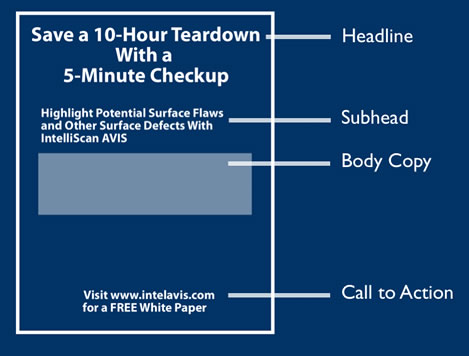
HEADLINE
The headline is the most important part of any marketing deliverable, and is your product’s most compelling sales benefit, as it is seen by your prospect.
A headline can be one word or twenty words, but it’s only goal is to pull readers in, and to get them to start reading the rest of your ad;
SUBHEAD
When printed beneath an ad’s headline, a subhead expands on the headline’s main benefit, for example, by providing more details on this benefit, introducing additional facts, product benefits, or features supporting the benefit expressed in the headline.
Subheads inserted throughout body copy to highlight secondary product benefits can also help busy readers get the gist of your product and its benefits without reading all of the body copy. And, let’s face it, most readers won’t read all of your ad’s body copy anyway, so subheads are a very important way to quickly communicate your product’s major benefits in shorthand form;
BODY COPY
Body copy is the main selling content of any ad or other marketing deliverable. In addition to presenting your product’s key sales benefits and features, your ad’s body copy must answer the most important questions a prospect would most likely have on your product or service, and move the reader to the fourth element of your ad, its “call to action;”
CALL TO ACTION
If a reader is interested in your product after skim-reading your ad (or brochure, Web site, flyer, or any other marketing piece), the call to action is your direct instruction to the reader telling him/her what you want them to do next—call your company, contact a distributor, or visit your Web site.
Here’s the place to include a savings, discount, or other promotional offer to provide an added incentive for readers to contact your company right now.
Creating a Sales Copy Outline
As a marketing or product manager, it’s likely you won’t be writing your company’s sales copy. But, you will be responsible for working with a copywriter at your ad agency, so it’s important for you to provide them with a sales copy outline of the major benefits of your product, to insure that your product’s most compelling sales benefits end up in the final ad, mailing piece, Web page or other marketing deliverable.
Next week, I’ll cover a sure-fire, three-step process to help you uncover and discover your product’s sales benefits, so you can develop a sales copy outline for any marketing project . . .
_____________________________________________________________
Reader Comments from Last Week’s Tuesday Marketing Notes
Responding to last week’s TMN on the importance of good marketing execution, John Brien (johnbrien@core.com) writes:
Dear Eric:
. . . These issues raise a larger question: how can marketing managers who blindly farm out work and miss deadlines manage to keep their jobs?
Answer: they work in dysfunctional organizations, where this type of behavior is acceptable. Where good marketing isn't understood, let alone appreciated. . . .
Dear John:
Yes, there are more than a few incompetent marketing managers out there hiding behind their desks in dysfunctional companies. However, sooner or later, the company’s VP of sales starts asking why the company’s ads aren’t generating sales leads for his sales reps, and why the mailing wasn’t ready in time for last month’s new product promotion.
When this happens, dysfunctional companies start becoming functional again, or they die. Or, as often, they wise up and hire a competent, sales-oriented marketing manager who knows how to execute, and the (now) ex-marketing manager gets a harsh life lesson.
The goal of the BMA’s new professional development programs (MSA/B/C) is to assess, train, and certify B2B marketing managers in the basic skills required for success in B2B marketing execuution, to train marketing professionals to execute effectively and well.
A marketing manager who can move the needle can move ahead, and this begins with solid tradecraft and good execution.
Comments? Questions? Send them to me at: eric@realmarkets.net
_____________________________________________________________
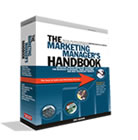
Eric Gagnon (eric@realmarkets.net), is president of GAA (www.realmarkets.net), a sales and business development consulting firm, and is the author of The Marketing Manager’s Handbook, the master study guide for the Business Marketing Association’s Marketing Skills Assessment, Skill Builder, and Certification (MSA/B/C) programs.
For more information on The Marketing Manager’s Handbook, available to BMA members at a special discount, link to:
http://www.businessmarketinginstitute.com/book.html
_____________________________________________________________
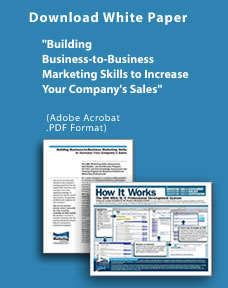
Test, Train, and Build Your B2B Marketing Skills for Better Sales Success: BMA Announces New Assessment, Training, and Certification for B2B Marketing Managers
For more information on the new BMA Marketing Skills Assessment, Skill Building and Certification (MSA/B/C) training and professional development program, visit http://www.businessmarketinginstitute.com