











Tuesday Marketing Notes (Number 53—October 3rd , 2006)
A B2B Marketing Newsletter for BMA Members
____________________________________________________________
MAKE SURE YOU CONTINUE TO RECEIVE EACH ISSUE OF TUESDAY MARKETING NOTES—CLICK HERE TO RENEW YOUR FREE SUBSCRIPTION
(NOTE: if you’ve already signed up previously at this link above, no need to do so again)
INDEX TO PAST ISSUES OF TUESDAY MARKETING NOTES:
Click here
Special Savings Promotion for BMA Members—Click here
–––––––––––––––––––––––––––––––––––––––––––––––––––––––
B2B Print Advertising (Part 6: B2B Display Ad Positioning )
by Eric Gagnon
The positioning of your print display advertising—where your ad is placed in a publication—also plays a role in determining the sales response generated by your advertising.
For example, a display ad buried within the last 12 pages of a publication, or worse yet, a fractional ad buried “in the back of the book” along with other fractional ads near the classified ad-style “Marketplace” section, may generate a response up to 25% lower than if the same ad was moved up within the first 20 pages of the same issue.
The best positions for your display advertising in any trade publication are:
• “Front of book:” In the “front half” of the publication, or—even better still—within the first 20 pages of the publication;
• Opposite relevant editorial: A display ad receives a boost by being placed opposite an article that’s highly relevant to the product or service being advertised. For example, an ad for a hydraulic pump placed opposite an article on the latest technical developments in the field of industrial hydraulics will usually get a nice “bump” in sales response by its proximity to this article;
• Right-hand side pages: Right-page ad placement is preferable anywhere in a publication, since right-hand side pages tend to stay open in the reader’s hand, if the reader is right-handed (as most of us are).
A publication’s production department usually controls the assignment and placement of all advertising space in a publication. A publication’s top advertisers, who run full-color, full-page ads in every issue, usually receive the best positioning within a publication. It’s an economic fact of life that your company’s annual advertising expenditures with a publication usually determine how much influence you’ll have in getting the most desirable placement for your company’s advertising.
Fortunately, you can still exert some influence on ad positioning in a publication, even if your company isn’t one of its top advertisers. Surprisingly, however, many advertisers and their ad agencies don’t even try to negotiate better positioning placement for their smaller ads, but it’s always possible.
Getting the Best Ad Position in a Publication
Even the smallest advertiser can exert some influence over where their ad will be placed in a publication, and smart advertisers in all page sizes do this all the time.
A publication’s advertising sales representative is your best advocate for helping you receive better positioning on your company’s ad placements. Since his economic livelihood depends on your continued ad placements in his publication, your ad sales rep is highly motivated to keep your company’s advertising business.
As a marketing manager, you have the most influence with your ad sales rep at the time you are planning a new program of ad space placements with the rep’s publication. This is the time you should push your ad sales rep the hardest, by pressing for one or more of these key ad placement terms:
• Front half-of book positioning;
• Preferred placement, opposite relevant editorial (more on this below);
• Positioning several pages away from your leading competitors A, B, & C
Although they’ll never admit it, your ad sales rep can often exert influence with their publication’s editorial and production departments to give your ad a better position, so the time to strike is when you’re negotiating your initial advertising order with the sales rep; this is when everyone wants to insure the best possible chance of success for your company’s new ad campaign.
Publication Editorial Schedules
Most trade publications publish, in advance, a month-by-month schedule covering the main editorial content of each upcoming issue of their publication, as in this example below:
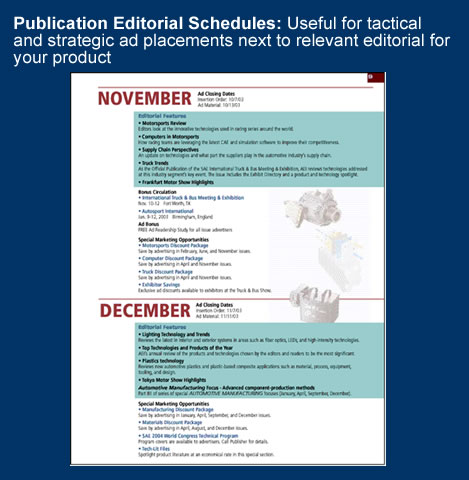
Examples of editorial topics addressed on these “Editorial Calendars” include:
• Key industry and regulatory issues;
• New products and technologies;
• Company/industry profiles and directories;
• Coverage of key, selected business markets and opportunities;
• Special, dedicated major annual trade show and convention editions
When these special editorial opportunities arise, it pays to plan ahead. For example, if an industrial publication’s main editorial feature for April covers plant automation, and your company sells plant automation software systems, you can modify your ad schedule by increasing your page size or placement for their April issue, so your ad appears in close proximity to a relevant, major article in this issue.
Special editorial editions can also provide your company with added PR opportunities. Ad placements timed to appear alongside special editorial editions can also be paired with special press release distributions and story placement contacts to key editors, increasing your chances of receiving editorial coverage on your company and its products in that special edition as well.
Ad positioning—If you don’t ask, you won’t get: There’s nothing to be lost by asking your ad sales rep what he or she can do to help your advertising get the best possible placement in his publication. The upside may well make the difference between a mediocre result from an ad placement, or a positive, profitable final result for your ad in the same issue. So if you don’t ask for the positioning you want for your ad, you’ll never know what your ad sales rep can do for you.
Tracking Your Ad Placement Schedule
As you plan your advertising schedule, you will need a simple, workable system for keeping track of the details of your company’s advertising program, to track and measure the response—sales leads and inquiries—your company receives from each ad.
A simple spreadsheet, like the one shown below:

. . .helps you keep track of all the pertinent details of your advertising schedule in a single worksheet.
Key cells from this spreadsheet, such as cost totals and responses, can be combined with other spreadsheets to create a year-at-a-glance summary worksheet detailing costs, response rates, and other important information on your company’s marketing activities.
Next week, we’ll cover the essential execution steps for print advertising programs . . .
Comments? Questions? Send them to me at: eric@realmarkets.net
___________________________________________________________
Attention Marketing Managers:
Get a Second Opinion on Your Marketing Program. . . FREE
Think you should be spending less and getting more from your current marketing program? Tired of hearing empty “branding” promises from your ad agency that never seem to translate to actual, measurable sales results?
Or, have you been losing out on important new selling opportunities due to poor execution in your marketing projects?
Let us give you a second opinion on your current B2B marketing program and deliverables, at no cost or further obligation.
For more information, contact us at: ericgagnon@verizon.net or click on this link below:

_____________________________________________________________
Eric Gagnon (eric@realmarkets.net), is president of GAA (www.realmarkets.net), a sales and business development consulting firm, and is the author of The Marketing Manager’s Handbook, the master study guide for the Business Marketing Association’s Marketing Skills Assessment, Skill Builder, and Certification (MSA/B/C) programs.
For more information on The Marketing Manager’s Handbook, available to BMA members at a special discount, link to:
http://www.businessmarketinginstitute.com/book.html
_____________________________________________________________
Test, Train, and Build Your B2B Marketing Skills for Better Sales Success: BMA Announces New Assessment, Training, and Certification for B2B Marketing Managers
For more information on the new BMA Marketing Skills Assessment, Skill Building and Certification (MSA/B/C) training and professional development program, visit http://www.businessmarketinginstitute.com