MAKE SURE YOU CONTINUE TO RECEIVE EACH ISSUE OF TUESDAY MARKETING NOTES—CLICK HERE TO RENEW YOUR FREE SUBSCRIPTION
How to Make Your Company a Thought Leader: Developing E-Mail Messaging Programs to Convert Prospects and Generate Sales (Part 1)
By Eric Gagnon
In last week's TMN, Ardath Albee covered some excellent examples of what to do and what not to do when writing lead sentences for e-mail messaging programs.
This week, I’d like to jump into the subject of running e-mail messaging programs in B2B marketing; specifically, executing e-mail programs for lead development programs for prospects who are already in the sales cycle and being contacted by your company’s sales team.
Lead development is the “marketing program after the marketing program,” an ongoing communications program, run in coordination with your company’s sales team, with the prospects generated as a result of your ongoing marketing program.
When developing an e-mail message program for lead development, think first about how you want to position your company, and then how you are going to utilize e-mail to meet this positioning. Generally, the ultimate goal of running editorial e-mail messaging programs is to establish a unique position for your company as a thought leader; that is, a company regarded as being the originator of the key concepts, technologies, and applications that drive the market served by your company.
“Show What You Know” is the Key to Achieving Thought Leadership
Thought leadership positioning is an especially valuable strategy for companies in mature or highly competitive industries: If you're selling Web security systems, here’s no point in being seen by your prospects as the 298th company in the Web security business. To break out from the rest, dig into your company, find what’s unique about its approach to its field, and utilize this information in your marketing and lead development programs to help you sell your company’s products by establishing its unique positioning in your market.
This method, which I call “show what you know,” can be the bedrock for developing the kinds of knowledge-based promotions that move prospects to contact your company instead of your competitors, and keep your company first in mind during the lead development process, as these prospects are contacted by your company’s sales team.
In addition to the obvious initial goal of demonstrating expertise and competence in your field, one of the best techniques for achieving thought leadership is to help prospects by guiding their evaluation process for buying products like yours. For example, companies who are thought leaders in a market help their prospects by providing them with the information they need in order to ask the right questions concerning their product, relative to the problem they need to solve by using their product. Quite often, these are crucial questions the prospect never knew to ask in the first place.
Helping prospects ask the right questions establishes credibility for your company and trust with prospects: If you can help your prospect ask the right questions and, more important, provide, through your thought leadership, the information they need to help them ask critical questions they hadn’t even thought of asking before, you build trust, and gain the inside track in the prospect’s buying process. Since you know the questions your prospects need to ask, the prospect assumes you have the best answers available, and will look to your product as the vehicle for solving their problem. That’s the benefit of being a thought leader.
This is very much a function of using the concept of “show what you know” to share your company’s unique expertise with your prospect base, and to provide an underlying stream of content that builds your company’s reputation and influences prospects over the weeks, months, or years they are in your company’s lead development pipeline.
This editorial communication occurs at the same time your sales reps engage your prospects, and while the prospect receives all of the other ongoing communcations in your lead development marketing program—other e-mail messages (such as special product announcements or price offers), print mailing promotions and print advertising, attendance at trade shows, etc.
Benefits of an Editorial E-Mail Messaging Program
Editorial e-mail messaging programs executed, managed, and measured within on-demand CRM systems communicate your company’s unique and specialized expertise to your prospects, to help your prospects:
• Learn more about the issues directly relevant to the buying decision related to your product;
• Learn how others have used your company’s products to help them solve the same or similar problems now faced by your prospect;
• Discover other aspects of their application or unique problem, so they can ask better and more well informed questions to help them in their final buying decision
Your role as a B2B marketing professional in developing and executing e-mail messaging programs is to serve as a developer of the content required for executing these programs in your company. This task does not require you to be a skilled editor or writer. What you do need, however, is the ability to:
• Recognize your company’s special expertise;
• Develop this expertise into forms you can communicate to your prospects
• Execute e-mail communications programs using the appropriate content forms, and
• Use on-demand CRM to manage, measure, and adapt your e-mail messaging program, as needed
Developing Your Company’s Expertise to Create Editorial E-Mail Messaging Programs: “Show What You Know”
Of course, the process of developing editorial e-mail messaging programs is a process of finding and developing content. The steps required to execute this process involve:
1.) Observing the issues, trends, and motivations in your industry;
2.) Finding and evaluating available content that exists, or can be developed,
within your company, and
3.) Matching this content to these industry issues, trends and motivations, and
producing this content to serve your lead development program
These tasks require an awareness of the basic skills of clear communication and empathy or identification with the interests and motivations of your prospects, which all of us have, or can easily develop. Usually, this process doesn’t require extensive research or information-gathering from outside sources, since most of the content you need can be found inside your own company.
Observing Your Industry’s Issues, Trends, and Motivations
There are always important issues, trends, and motivations that drive an industry and your prospects who work within your industry. Many of these issues, trends, and motivations can be tied directly or indirectly to your product or service, to the benefit of influencing prospects to move closer to buying your product. These terms are defined as follows:
An issue is a topic of discussion, a concern, or an outcome of an event that is widespread in your industry. Industry issues are commonly repeated in trade publication articles in print and online, on industry-related weblogs, or in panel discussion topics at trade conferences, among other sources;
A trend is an influence to an industry which occurs over a longer term. A trend is an issue on the move. Trends often lead to major changes in an industry, and may not be perceived at first by many who work in the field. Trends move an industry forward, and usually benefit companies who position themselves and their products early enough to take advantage of them. Trends can sometimes be found in your industry’s trade media (usually online before appearing in print), but those who are working daily inside your industry—your company’s sales reps, for example—may be the first to hear of the newest trends in your marketplace. For every trend, and especially for trends that develop over some time, there may be countertrends—growing reactions, responses, or movements that arise in opposition to the trend.
For example, a trend such as outsourcing may one day spark a countertrend which develops against it, where companies become aware of the need to protect and maintain core knowledge functions in their operations, such as development of proprietary IT applications. Sometimes it is more beneficial to position your company on a countertrend instead of a trend, to help it establish a truly unique position in your market.
A motivation is a behavior characteristic that makes your prospect act in the way they do, or a cause that forces your prospect to act in response to a change or condition in their working environment. The natural ideal state desired by many prospects who work in your industry is the status quo—i.e., “doing nothing.” Issues and trends work to change your prospects’ environment, and motivate them to adapt, respond to, or otherwise act on these changes. Aside from motivations caused by issues or trends, prospects in every industry—and all of us—hold universal motivations in our business environments:
• Boosting top-line revenues through increased sales;
• Improving operations;
• Increasing efficiency or productivity;
• Cutting costs to improve profitability;
• Avoiding negative consequences, such as legal liability or business failure;
• Achieving a proprietary or competitive edge;
• Risk aversion, by making “safe” choices to meet the need for job security
Issues and trends ultimately motivate your prospects to act according to universal business motivations such as these. Also, the sales copy and messaging used in your company’s marketing program is (or should be) focused squarely on positioning your product to address and influence these universal business motivations.
The chart below shows some examples of issues, trends, and motivations for industries that are well known to most of us:
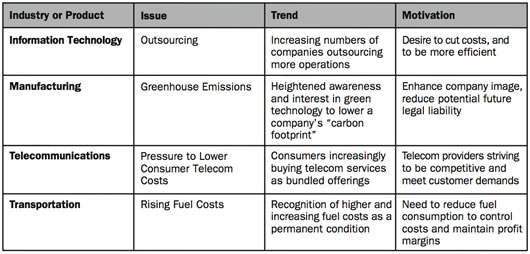
Even though the issues and trends for your industry are likely to be far more specialized, involving technology, changes in processes, markets, and business methods known only to prospects in your market, the same principles hold true for developing editorial content focused on your company’s relationship to these issues and trends, and that’s what we’ll cover next week . . .
Comments? Questions? Send them to me at: eric@businessmarketinginstitute.com
Eric Gagnon (eric@realmarkets.net), a director with the Business Marketing Institute, is author of The Marketing Manager’s Handbook and The CRM Field Marketing Handbook, and president of GAA ( http://www.realmarkets.net ), a marketing, sales turnaround, and product development consulting firm.