











Tuesday Marketing Notes (Number 52—September 26th , 2006)
A B2B Marketing Newsletter for BMA Members
____________________________________________________________
MAKE SURE YOU CONTINUE TO RECEIVE EACH ISSUE OF TUESDAY MARKETING NOTES—CLICK HERE TO RENEW YOUR FREE SUBSCRIPTION
(NOTE: if you’ve already signed up previously at this link above, no need to do so again)
INDEX TO PAST ISSUES OF TUESDAY MARKETING NOTES:
Click here

Special Savings Promotion for BMA Members—Click here
–––––––––––––––––––––––––––––––––––––––––––––––––––––––
B2B Print Advertising (Part 5: B2B Ad Frequency: How to Look Like a Big-Time Advertiser on a Small Ad Budget )
by Eric Gagnon
Last week we covered trade publication choices, and how to scout out trade media for new advertising programs using SRDS trade media directories. This week, let’s talk about placement and scheduling for your advertising programs.
Of course, it takes more than one insertion to build awareness in an advertising program, and to maximize its sales response. Basic human nature shows why, since, as a rule, most people—your potential prospects—are too preoccupied to pay attention to most advertising, including yours.
Your readers may, or may not, remember your company’s product when they have a need for it, and they may, or may not, connect your ads with their need for a product like yours, or with their faulty memory of the ads they’ve seen recently for a product such as yours. A reader, for example, may only glance at your ad in the first issue, may miss it entirely in the second, and may then respond to it by the third (or fourth) issue.
A three-issue insertion, spread across any three consecutive issue dates of a publication (whether weekly, bi-monthly, or monthly) is the minimum length of time necessary to give your advertising the chance to build awareness in that publication, and to tell you if print advertising is an effective addition to your marketing program.
Dialing in Your Ad Size to Frequency
The trick to determining ad frequency is, given the limited advertising budgets most of us work with in small to mid-sized B2B companies, is to dial in the best combination of ad size to frequency to run for your own advertising program.
Your best bet is to run the largest ad size you can afford, at a minimum three-time insertion frequency, in the top two publications in your industry, based on the “two publications rule” covered in last week’s TMN (see link here: http://www.businessmarketinginstitute.com/tmn091906.html. Three placements (a “3X frequency”) are sufficient to tell you whether or not your new advertising program is working.
For example, if you have a $30,000 print advertising budget, split more or less evenly between the top two publications in your industry, select the closest ad size that allows you to spread each ad across three consecutive issues in each publication:
$30,000/3 insertions X 2 publications (6 placements total) = $5,000 per ad
Select the ad size closest to the amount ($5,000) calculated above for each ad placement. If this means you can afford full or half-page ad sizes, then these are the sizes you should run.
However, in our example, even if the $5,000 per ad/placement figure pushes you down in size from a half-page horizontal to a smaller, one-third vertical or quarter-page, you should still be able to effectively tell your company’s story and sell your company’s product in these smaller sizes.
If, on the other hand, $5,000 per insertion allows you to buy a full-page ad at a three-time frequency, you should, nonetheless, seriously consider a smaller ad size run as your initial test. Ask your ad agency to produce your ad in the smaller space size, run the ads, and track your results. After all, if you can make a half page ad pull the same response as a full page ad, why would you spend nearly twice as much to run full pages? For more information on producing small ads, see our previous TMN at: http://www.businessmarketinginstitute.com/tmn102505.html
Ad sizes and testing: Skillful creation and smart placement of fractional ads is even more important when you are seeking to minimize your risk and expense by testing under the following conditions:
• Generating sales response for an existing product in a new market;
• Launching new products in new markets;
• Running new ad campaigns and sales approaches;
• Ad placement tests in new publications
In any of these circumstances, starting conservatively with a 3-time frequency run of fractional ads will always give you a solid initial reading on a product’s likely sales response from advertising. It also permits you to hold more marketing dollars in reserve, in case your ad campaign requires further adjustment, or if other marketing methods (such as direct mail or trade shows) prove themselves as more productive sales response generators in your marketing program.
How to “Flight” Your Advertising Schedule to Stretch a Small Ad BudgetAs we’ve just said, you want to run a minimum three-time insertion schedule in your industry’s top two publications. You can usually begin to tell whether an advertising program will be successful about 45 days after the first ad appears. Once your ads have had a chance to generate sales response (inquiries, leads, or orders), and once you’ve had the chance to measure and analyze this response, you can then expand your advertising schedule to more publications in your field, across longer frequency periods, while continuously tracking the response to each ad placement.
However, if you’re in a start-up company, or if you want to move more slowly (i.e., you don’t want to risk spending those extra advertising dollars too soon), you can “flight” your ad placements by running your first three ad placements in a single publication for the first three months (or issues) of your schedule, then switching to another publication for the next three-month (or issue) run.
For example, a typical ad annual schedule of ads, “flighted” by publication, might look like the table below:
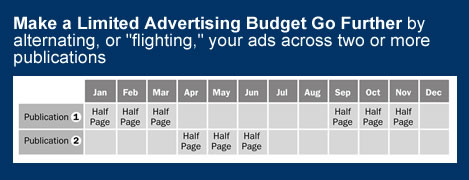
For Publication 1, half-page insertions are run twice in three consecutive issues (six insertions annually) from January-March, and September-November. After March, the next three-issue flight of ads runs in Publication 2 for April-June. Also note there are no placements in either publication during the summer vacation months of July and August, when advertising response in trade and business-to-business publications typically increases your risk when making untested ad placements.
In a variation of this schedule, since there would be sufficient time to measure response to ad placements in both publications from January to June, the advertiser might want to run in both publications from September to November, and not just in the flighted three-issue placement shown for Publication 1. This would give the advertiser an aggressive promotional front for the active business months of September to December, and with minimized risk, since, by this time, the ads would have had a full six months to prove their sales response in both publications.
This technique can be used for any number of publications, and in a variety of combinations, to minimize risk, and to stretch your advertising budget. Flighting offers the added benefit of giving your market’s audience the impression you are advertising in all the publications in their industry simultaneously, without the cost of actually doing so, and seems to work especially well for maximizing the expense of fractional ads.
Next week, we’ll cover display ad positioning, and strategic placements to match your product advertising to a publication’s editorial schedule . . .
Comments? Questions? Send them to me at: eric@realmarkets.net
_____________________________________________________________
Attention Marketing Managers:
Get a Second Opinion on Your Marketing Program. . . FREE
Think you should be spending less and getting more from your current marketing program? Tired of hearing empty “branding” promises from your ad agency that never seem to translate to actual, measurable sales results?
Or, have you been losing out on important new selling opportunities due to poor execution in your marketing projects?
Let us give you a second opinion on your current B2B marketing program and deliverables, at no cost or further obligation.
For more information, contact us at: ericgagnon@verizon.net or click on this link below:

_____________________________________________________________
Eric Gagnon (eric@realmarkets.net), is president of GAA (www.realmarkets.net), a sales and business development consulting firm, and is the author of The Marketing Manager’s Handbook, the master study guide for the Business Marketing Association’s Marketing Skills Assessment, Skill Builder, and Certification (MSA/B/C) programs.
For more information on The Marketing Manager’s Handbook, available to BMA members at a special discount, link to:
http://www.businessmarketinginstitute.com/book.html
_____________________________________________________________
Test, Train, and Build Your B2B Marketing Skills for Better Sales Success: BMA Announces New Assessment, Training, and Certification for B2B Marketing Managers
For more information on the new BMA Marketing Skills Assessment, Skill Building and Certification (MSA/B/C) training and professional development program, visit http://www.businessmarketinginstitute.com