MAKE SURE YOU CONTINUE TO RECEIVE EACH ISSUE OF TUESDAY MARKETING NOTES—CLICK HERE TO RENEW YOUR FREE SUBSCRIPTION (IF YOU'VE ALREADY SUBSCRIBED, NO NEED TO RE-SUBSCRIBE)
The Care and Feeding of Social Media
for Business Marketers: Integrating Your Offline Advertising With Online for Content-Based Marketing Programs (Part 5)
by Eric Gagnon
Sure, everyone says you should be using social media, but can you really use it effectively for the critical tasks you get paid to accomplish, like lead generation and moving the sales needle in your company? Truth be told, social media is new to all of us, and even the founders of big social sites like FaceBook and Twitter are still searching for their business model. However, social media is at the same early stage of development that e-commerce was on the Internet back in 1995. Those who got in early gained the advantage over their competitors as more consumers started to buy online, and the same is likely to happen as social media continues to change the relationship between companies and their prospects and customers in B2B.
Even if the smart guys at the social media sites haven’t figured out how to make money with their own services, you can get a return from social media on your own B2B marketing programs by using social media as the vehicle for linking prospects in your market to the content you produce. No matter how half-baked social media seems today, as a business marketer there’s still no substitute for getting your content out there squarely in the middle of it, to generate interest, comment, and interaction with prospects in your market who are using it. And it’s certainly better to get your company out there now, than to leave social media to your competition. Think of social media as another, increasingly important element of your marketing program that will become more important as it evolves into more useful and more effective forms.
Using Social Media: A Content-Based Marketing Scenario
The current (conventional) approach: For example, let’s say your company sells an anti-corrosion coating process to manufacturers. The conventional marketing approach would be to run ads with either a catchy headline or (better) a strong sales benefit about this process, a product shot, and some body copy, and some copy to get readers and viewers engaged enough to link to your Web site or call your sales rep.
As we discussed last week, this is how most companies produce advertising today, with variable results. For many advertisers, it’s not working as well as it used to because prospects aren’t paying attention anymore. Not when they can Google the keywords describing your product and compare and evaluate pages of factual detail on virtually all available solutions to their corrosion problems.
The post-marketing (content-based) approach: Now, take the same product, but focus instead on developing content that can help prospects address key concerns or solve common problems in their field, using products like yours. For example, you could write a report describing how your anti-corrosion coating uses fewer hazardous chemicals, and explain, using solid financial analysis, how this reduces a typical customer’s actual waste disposal and insurance expenses compared to using other coatings offered by your competition. Use actual numbers derived either from your current customers’ operating results, or based on industry-recognized data sources, such as trade associations or industry research firms.
Executing Content-Based Marketing Programs Using Social Media
Once you develop the content, the best use for online and social media for lead generation is to use this content as a token of exchange for attracting the attention of the prospects in your market who are using online and social media, and to draw them closer to the point where they will contact your company and become prospects.
Here’s how you can utilize online and social media to deliver this content to your market:
• Summarize this report in a post on your company’s blog;
• Introduce this new report by highlighting it on your CEO’s (and your company’s) LinkedIn and Facebook pages;
• Refer to this report on postings to other members of LinkedIn industry-related groups, such as groups serving the insurance and “green business” fields;
• Refer followers and others to this new report on Twitter postings;
• Ditto for tweets where relevant, following “insurance” and “green business” Twitter users;
• Start a new group on LinkedIn related to the topic of anti-corrosion coating systems, and put a key product or technical executive at your company in charge as moderator of this new group;
• Produce a very simple, 2-minute narrated video summarizing this report, and featuring clips of your coating process in action. Post on YouTube, using relevant keywords, and also at an easily-found location on your company’s Web site;
• Put out a press release announcing this report on PR Newswire or PR Web, so it will be picked up by Google and other search sites and news feeds. Use relevant keywords in your release, which will be picked up by Google when the release is distributed to news sites. Also post this release to your site, under the same keyword group;
• Organize a phone call and e-mail contact campaign for your sales reps to contact their prospects in your company’s sales pipeline to them about this new report;
• Run a webinar for prospects to present the key points of this report, and set up a post-webinar discussion session on Twitter for webinar participants to answer questions and interact with these prospects;
• Use this report as the basis of a Google AdWords keyword search ad campaign, offering it free to searchers who enter the keywords that define or describe problems solved by your product;
• Feature this report in your weekly e-mail newsletter to prospects in your lead development system
Did you notice how none of these 12 activities involved a print ad, mailing piece, or other conventional marketing deliverable? Did you also notice how most of these activities can be executed at little or no cost? With so many different options for using online and social media as a means for moving content, the fact that many B2B advertisers are shifting their budgets from conventional to online marketing shouldn’t be a surprise.
To Multiply The Power of Online and Social Media, Integrate It with Your Offline Marketing Program
However, even though there’s much you can do using online-only marketing media, you can get even more power and response by combining online media with offline media, especially direct mail, which many online marketers are just now re-discovering. There’s no substitute for putting a direct mail piece in a prospect’s hands, or getting your print ad in front of them when they open a trade publication.
Here’s an example of a full-page ad layout (which could also be used as a direct mail piece) to publicize the report detailing savings and efficiency of this company’s anti-corrosion process:
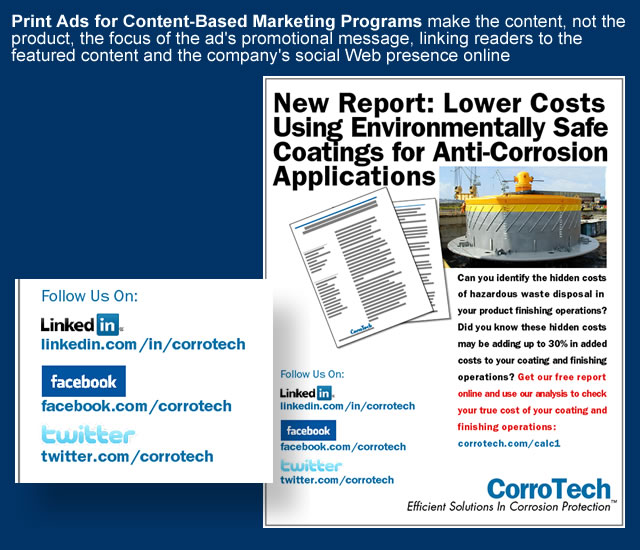
In this example, we are using the print ad layout to promote the content, not our product, which is the key difference between content-based marketing programs and conventional B2B approaches. Also, note how this ad serves mainly as a gateway for the reader, encouraging them to link directly to the content online and, significantly, to the company’s social media links, enlarged in the cutaway above.
There is power in integrating offline to online marketing media, and in integrating offline advertising across social media. The key to adapting yourself to the collapse of B2B marketing as we know it is to learn how to develop the content related to your product that prospects in your market will find useful, and developing new, post-marketing methods to let your prospects know about this content.
Do this and you will also have a fighting chance of measuring accesses to your content, capturing lead information, tracking these leads through your sales pipeline, and linking your expenditures on these new kinds of ads to the actual revenues generated. These critical features—market utility, measurability, and accountability—the hallmarks of success using content-based marketing programs, insure your continued professional success in the post-marketing era.
Eric Gagnon (eric@realmarkets.net), a director with the Business Marketing Institute, is author of The Marketing Manager’s Handbook and The CRM Field Marketing Handbook, and president of GAA ( http://www.realmarkets.net ), an interactive marketing, turnaround, and product development consulting firm.