











Tuesday Marketing Notes (Number 21—February 14th, 2006)
A B2B Marketing Newsletter for BMA Members
____________________________________________________________
MAKE SURE YOU CONTINUE TO RECEIVE EACH ISSUE OF TUESDAY MARKETING NOTES—CLICK HERE TO RENEW YOUR FREE SUBSCRIPTION
(NOTE: if you’ve already signed up previously at this link above, no need to do so again)

Special Savings Promotion for BMA Members—Click here
–––––––––––––––––––––––––––––––––––––––––––––––––––––––
Two Big Things: How to Achieve Lifetime Job Security in Your Marketing Career
Tom Agler, president of the BMA’s Cincinnati chapter, recently sent me an e-mail, suggesting I present a list of 10 success tips and mistakes for every marketing professional. I’ll have my top 10 next week, but as I was writing these there were two big things that were so important I felt they deserved their own column.
So, with thanks to Tom, here are two of the biggest pieces of advice—one is a “don’t,” and one is a “do:” Follow these and you’ll develop a mindset and skills that will make you a valuable member of your company’s (or client’s) management team, in good times and bad.
Job Security Tip #1:
Focus on Your Tradecraft, and Don’t Listen to the Grand Master Strategist Baby Geniuses of Marketing (GMSBGOMs)
Most of what’s written about marketing these days is puffed up, pretentious high-concept fluff that’s irrelevant and potentially fatal to your career as a B2B marketing professional: A focus on soft management platitudes and broad, consumer branding principles, and fuzzy theories instead of the practical advice you can apply to your own marketing program, today.
This criminally negligent marketing advice, combined with the inflated sense of self-esteem instilled in children from the late 70s onward by our lousy public school systems, has spawned a whole generation of young, articulate, incompetent dreamers in American business.
A lot of these folks ran marketing programs for overfunded dot-coms during the late 90s, where they participated in the great wealth transfer from venture capital funds to ad agencies, throwing millions and millions of dollars away on egregiously wasteful advertising. Since the dot-com crash, most are now working at Starbucks, The Gap, and Google, where at least they are no longer a threat to your company’s B2B marketing program.
The dot-coms are a faded memory but the legacy of pie-in-the-sky branding strategy over practical marketing tradecraft that creates sales lives on, in the Grand Master Strategist Baby Genius of Marketing (GMSBGOM). You can find GMSBGOMs working as marketers both inside larger B2B companies, at start-ups, and on the agency side.
They’re the ones who tell you the solution to your new product’s current sales slump is to “re-contextualize your business model,” by “maximizing the brand experience,” to “monetize the user clickpath,” so that you’ll be “acquiring mindshare,” when what you really need them to do is to figure out how to get your marketing program back on track, and get your sales up next month.
If you’re a young person in B2B marketing, my best advice to you is to tune out every GMSBGOM you meet, and do your best to unlearn most of what you were taught in your college marketing classes. Most of that stuff applies only if you go to work for a big consumer brand like Procter and Gamble, and not a small to mid-sized B2B company—which is where most of the marketing jobs are. Buy and read every advertising book ever written by John Caples, Claude Hopkins, Rosser Reeves, Gene Schwartz, and Stan Cotton, and stay focused on developing your personal tradecraft of clear presentation and effective execution in your marketing program, to sell your company’s product.
What is tradecraft? These are the basic skills of marketing, such as copywriting, presentation, basic design know-how, and marketing execution for all of the activities in your B2B marketing program. Tradecraft is the basic skillset you need to do your job as a marketing professional, inside a company, or on the client side.
And I offer this advice especially to women in the marketing field: The best way to break through that “glass ceiling” in the corporate world is to increase sales and open new business opportunities in your company. Show the big boys you can make the phone ring. You will do this if you learn and build your personal tradecraft of marketing. You won’t do it by being the Grand Master Strategist Baby Genius of Marketing, like some of your fellow cubicle dwellers. Be like Margaret Thatcher, not Carly Fiorina. Got it? Good!
Marketing is Mostly Tactical
Sure, the high-concept elements of marketing strategy are important—positioning, trends, pricing, distribution, etc., but once they’re set in your marketing program, the rest is all tactical: The process of marketing execution that drives all of the deliverables and activities of your marketing program.
Marketing executionis what gets your promotional mailing out to your customer base ahead of your major competitor’s product launch announcement. It gets your ads created and placed, and puts the action steps for next month’s trade show appearance back on track. Your execution gets your presentation produced for the key account reps who get in front of the major corporate prospect, where your company’s biggest new deal of the year is done.
Tactical marketing execution is where the game of marketing is won or lost, and it’s what separates the doers from the incompetent dreamers in B2B marketing. You develop your skill at marketing execution by developing your tradecraft. And in the long-run, it’s the doer, not the dreamer, who moves ahead in any reasonably non-dysfunctional company.
Job Security Tip #2: Never Forget that Marketing is Accountable to Sales
There’s a lot of talk these days about how marketing staffs must defend their turf in companies, and how marketing managers need to justify their function, for example, by measuring the ROI of their marketing efforts.
I see desperate marketers grasping for these straws whenever the marketing manager has separated him/herself from their obligation to serve their company’s sales team. And the fact that this is such a popular topic these days tells me there’s a lot of fat, stupid, ineffective marketing going on out there.
It’s funny: When their ads and mailings are pulling good sales leads, I never see marketing managers thinking they have to “justify” their roles, or “quantify” their marketing programs. I only see it when sales departments are grumbling that their company’s expensive, fluffy advertising program isn’t generating any actionable sales response in the form of qualified sales leads and inquiries.
When a marketing manager is working with their sales VP to develop ads, mailings, and deliverables that effectively sell their company’s product, and these marketing activities are keeping the company’s sales team supplied with a steady stream of high-quality leads, and the marketing manager is out in front, looking for ways to open new business opportunities in the marketing program, the marketing department is never asked to justify itself.
The marketing vs. sales issue is also wrapped up in office politics, where those who say that marketers aren’t accountable to their company’s sales team do so because they believe the marketing role deserves special, separate standing; or, by staying focused to the need to generate sales response, marketers will somehow make themselves “politically” subservient to sales, thereby hurting the marketing manager’s career. The reality is that this line of thinking is very dangerous to your career.
By the time anyone in the company starts to question the expense of “brand image” ads that aren’t pulling, or expensive marketing activities that aren’t generating leads for the company’s sales reps, the time for justification or defense is over, because these are sure signs that the marketing program went off the rails months earlier.
The Role of Marketing is to Serve and to Lead
Marketing serves a two-pronged role in B2B: It is both the staff service function to sales, and the advance new business-building function for the company. As a marketing professional, your job is both to support sales in the here and now, by producing deliverables and marketing programs that generate sales response—inquiries, leads, and orders—for your company’s (or client’s) sales team, and to get out in front of your marketing program to anticipate and capitalize on new, future opportunities: Creating a new promotion for your product in a new market, developing a new marketing program to publicize a new compliance or regulatory change that can be met by your product or service, launching an innovative promotional offer to counter a competitor’s new product announcement, and preparing a high-level business development presentation for a major corporate partner are but a few examples of ways you can keep your marketing program forward-looking, to anticipate and capitalize on future opportunities.
Of these two roles, one serves sales in the here and now, and the other helps sales by opening new initiatives to sell your company’s product and create new business for your company or client. In B2B, viewing the marketing department as some kind of separate, special function that tends to your company’s ethereal pursuit of its own brand image is a dreamer’s delusion.
It All Comes Back to Your Tradecraft
Both the here-and-now and out-ahead functions of B2B marketing require tradecraft—the essential skills that you, as a marketing professional, need to move your program forward:
• Are you debriefing your company’s sales reps to discover the sales benefits that actually motivate real, live human beings, so you can modify these for use in sales copy in your marketing deliverables?
• Are you producing ads, mailings and other deliverables with the prime goal of generating leads for your company’s sales team?
• Are you using e-mail newsletters, autoresponders, and other techniques on your company’s Web site to establish a communications dialogue with individuals in your market, to draw a steady number of inquiries from these interested prospects?
• Are you tracking, and counting, all inquiries you receive from every marketing activity?
These are but a few of the areas where your tradecraft, applied to marketing execution, keeps your marketing program engaged, relevant, and successful to your company’s goal of making sales.
Be skilled in your tradecraft, don’t be (and listen to) a Grand Master Strategist Baby Genius of Marketing, and never forget that your function as a marketing professional is to serve the sales function of your company or client. Do these things and you’ll never have to justify yourself in any marketing job you ever hold.
Next week, I’ll cover the top ten mistakes marketers make (and how to stop making them) . . .
Comments? Questions? Send them to me at: eric@realmarkets.net
_____________________________________________________________
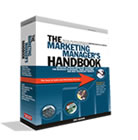
Eric Gagnon (eric@realmarkets.net), is president of GAA (www.realmarkets.net), a sales and business development consulting firm, and is the author of The Marketing Manager’s Handbook, the master study guide for the Business Marketing Association’s Marketing Skills Assessment, Skill Builder, and Certification (MSA/B/C) programs.
For more information on The Marketing Manager’s Handbook, available to BMA members at a special discount, link to:
http://www.businessmarketinginstitute.com/book.html
_____________________________________________________________
Test, Train, and Build Your B2B Marketing Skills for Better Sales Success: BMA Announces New Assessment, Training, and Certification for B2B Marketing Managers
For more information on the new BMA Marketing Skills Assessment, Skill Building and Certification (MSA/B/C) training and professional development program, visit http://www.businessmarketinginstitute.com