











Tuesday Marketing Notes (Number 67—January 30th, 2007)
A B2B Marketing Newsletter for BMA Members
____________________________________________________________
MAKE SURE YOU CONTINUE TO RECEIVE EACH ISSUE OF TUESDAY MARKETING NOTES—CLICK HERE TO RENEW YOUR FREE SUBSCRIPTION
(NOTE: if you’ve already signed up previously at this link above, no need to do so again)
INDEX TO PAST ISSUES OF TUESDAY MARKETING NOTES:
Click here
Special Savings Promotion for BMA Members—Click here
–––––––––––––––––––––––––––––––––––––––––––––––––––––––
Three Steps to Targeting a New Market: (Part 2: The Tools of Our Trade, and How—and Where—to Begin)
by Eric Gagnon
Last week, we discussed the unique challenges of targeting a new market, whether it’s from your role on the inside as a marketing or product manager, or from the agency side, helping a client with its entry into a new market. This week we go deeper into the process, describing the marketing methods, or tools you can use to crack a new market, and which of these tools to use.
Once you’ve done your homework—for example, by gathering the sources for mailing lists, and publication advertising opportunities we covered during last week’s TMN on background research—you are now ready to plan the first steps in your new marketing program. This week, we’ll start describing the major marketing methods you’ll be using in your program, their pros and cons and, most important—how to begin using these tools to get a new marketing program underway to start generating sales leads and inquiries for your company, or your client.
This “how to begin” aspect is critically important when launching a new marketing program in a new market. When you’re entering a new market, you never know whether print advertising, direct mail, or any other marketing method works best (or works at all) to generate sales response for your company or client; at best, you run the risk of burning up more of your marketing budget on methods that don’t work as well as you had hoped—and at worst, you take foolish risks by spending your marketing money on methods that don’t work at all.
The process of entering any new market using these marketing tools is a variation of any market testing you’d perform for a new product launch or a start-up. In fact, the ability to test is an important aspect of any marketing tool where response that can readily measured, such as direct mail and online marketing, so it’s important for you to test new sales messages, deliverables, and promotions while you roll forward with your new market entry.
You’ll never know if there’s a better way to sell your product unless you try it, so this is why you test. We’ll describe a few of the ways you can test your product while you begin your marketing execution in your new market.
There Are Just Five Ways to Market Your Product
When you cut through the stuff and nonsense that’s being written about marketing these days that makes it far more complicated than it really is, there are only five ways to market your company’s product in any B2B marketplace:
1.) Direct Mail
2.) Trade Shows
3.) Print Advertising
4.) Internet and Online Marketing
5.) PR and Free Media
These are the tools of our trade. Using one, two, three, or all of these tools, budget permitting, your challenge is to develop a marketing program to generate sales response—inquiries and sales leads—for your company’s sales team.
If you’re a marketing manager or agency working with any company that sells its products or services utilizing a sales team—and this means most companies in B2B markets—then this critical sales support function is your primary responsibility as a marketing manager.
1.) Direct Mail
Direct mail, and direct mail combined with telemarketing follow-up, are the mainstays of most B2B marketing programs. Even with today’s growing popularity of Internet-based marketing, you can’t beat the power of putting your company’s self-mailer, brochure, sales info kit, or other printed material into the hands of your potential prospects: A printed, four-color brochure, cover letter, or spec sheet delivered to a potential buyer makes your company “real” to that person in a way that can’t be matched by a Web page or keyword search link.
The other big advantage of direct mail is its flexibility, and its scalability: Direct mail projects can take many forms, from a handful of highly personalized cover letters and high-level sales presentation kits mailed out to the top CEOs in your field, or a few hundred mailing pieces sent to your best, cherry-picked prospects for a special promotion, all the way to big, 100,000-piece product announcement mail drops to trade publication subscriber lists.
Your ability to scale many direct mail projects begins with the fact that most mailing projects can be tested, which is direct mail’s major advantage over other marketing activities, such as print advertising. Scalability is especially important when launching a new marketing effort, since the $15,000 or less you spend on initial test mailings can help you dial in everything you need to know to tell whether you have a business in your new market, or what you need to change or improve in the way you’re addressing this new market, such as presentation of your major benefits, your offer, or the potential prospects you’re targeting.
Direct Mail with Telemarketing Follow-up is an Unbeatable Combination
You can often coordinate your direct mail programs with telephone follow-up by your company’s sales reps, which dramatically increases response rates on mailings by enabling your sales reps to gauge interest, answer the potential prospect’s questions, qualify the prospect, and otherwise jog their prospects a little closer to their purchasing decision.
Wherever possible, you should execute mailings that include this close telephone follow-up by your company’s sales reps: This followup not only boosts response rates on your mailings, it gives the sales rep a reason to call the prospect. Sales reps always appreciate having a good promotion they can get on board with, one that helps make their job of facing prospects easier, and your prospect appreciates having some real information on hand about your product before the sales rep calls.
This one-two step of direct mail with phone follow-up eliminates the need for your sales reps to do any cold calling, which they all hate anyway—and rightly so. With phone voicemail systems in offices everywhere these days, sales reps attempting cold calls can rarely get to a real live person anyway; and those on the other end of the call usually find cold-calling cheesy and intrusive. To me, any company that has to make its sales reps do cold calls isn’t running a functional or competent marketing program.
Direct mail with telephone follow-up has the added benefit of giving you invaluable feedback on your marketing program, as prospects tell your company’s sales reps which benefits or product features they found most compelling about your mailing and your sales content, and give you ideas for new benefits and unique positioning you might have never thought of on your own. Smart marketers know how to listen, and will change their marketing messages and deliverables in response to what they’re hearing from their customers and their sales reps, to improve their marketing programs.
Developing Your Best Mailing Lists for Direct Mailings to New Markets
Every successful direct mail project begins with a good mailing list: Before you plan other aspects of your project, such as your direct mail package and every other detail in your mailing program, you need to put together the best mailing lists you can find, rent, or build. Of these, the best mailing lists are the ones you build yourself.
For example, you can begin the process of creating great self-compiled mailing lists by gathering names of potential prospects by job title from trade association mailing lists, and by taking down prospect names (also by job title) from the “management team” links from Web sites for the companies you’re targeting in your market.
The “Dumb Assistant Method:” Another extremely effective way to build highly targeted mailing lists is to use what I call the “Dumb Assistant Method,” where an administrative person in your company calls to request the name of the person most likely to buy your product.
Your “Dumb Assistant” sounds and acts like a high-level executive secretary, calling the target company to ask the following question:
“I’ve been asked to send materials to someone who handles [your application, field, or need here] at your company, and I just don’t know who to talk to. Could you please connect me to someone in that department at your company?”
—your staffer will then be connected to an administrative assistant or some other lower-level employee in that department at the company. Your staffer should then ask this person:
“I don’t know if you’re the right person I should be speaking to about this, but I’ve been asked to send some information to someone in your company who handles [put your own company’s very specific product application area here]—could you tell me who that person would be?”
It may take your “Dumb Assistant” three or four turns to get the name, phone number and address of the right person in the company, but once this contact is obtained, it’s an extremely valuable addition to your company’s self-compiled prospect mailing list, because you’ve just targeted a prospect that’s more qualified and probably more up-to-date than many of the names you’d be able to get from a rented mailing list somewhere else.
If you need to build bigger mailing lists in a hurry, you can also hire articulate, aggressive temps and set up your own phone bank, increasing the number of “Dumb Assistants” to help you build your own self-compiled mailing lists, and in a week or two you’ll have a prospect list you couldn’t buy or rent anywhere else. In fact, there aren’t any better prospect lists available than those you build yourself using this method.
To give you one example of how effective this method can be, a client of mine used this method to compile a killer prospect list in his industry. This list, along with great marketing execution, helped him take his company from $800,000 to $12 million in 18 months, and from nowhere to #2 in his industry—proof positive that this “Dumb Assistant Method” is a pretty smart way to build mailing lists that generate sales response.
How to Begin a Direct Mail Marketing Program
Once you have your mailing lists nailed down, you need to plan your initial mailings into your new market. Next to Internet and online marketing methods, direct mail is the most “testable” of all marketing methods, and you should take advantage of this aspect when starting direct mail projects in your new markets. You can—and should—test every major direct mail element in your program: Mailing lists, direct mail packages, promotional/price offers, and sales copy approaches.
One of the ways you can begin your new direct mail program is to mail your best self-compiled list (often developed with the help of the “Dumb Assistant” method), and a test mailing of 5,000 names to potential prospects, selected by job title, from the industry’s leading trade publication. A single test mailing to the best targeted prospects in your industry’s best publication is a rough initial measure of whether direct mail will be effective in your marketing program.
However, if you are working with many unknowns in your selling copy approach or positioning, or you are trying to get a handle on your product’s pricing or promotional options, instead of one 5,000-name test to the publication, you could drop three mailings of 5,000 names, each selected from this trade publication (15,000 names total), with each of these mailings testing a different direct mail package using a different major selling benefit.
Testing multiple mailing pieces: When testing copy approaches on direct mail packages, you get the most from your test by trying out three very unique, independently-written mailing pieces. If you’re a marketing manager inside a company, ask your agency to come up with their three best sales copy messaging approaches and/or promotional offers; if you’re on the agency side, develop these three on your own.
For example, when I develop a direct mail package for a client, I try to develop one mailing piece for each of the “hot button” motivators that drive the potential prospect: These usually include a first mailing piece highlighting a positive sales copy attribute, such as increased productivity, greater profit or efficiency, a second piece highlighting what I call “negative” sales copy attributes; for example, what happens to the reader if they don’t use a product or service as great as my client’s. The third mailing piece we produce is usually a fairly straight, “safe” presentation of the client’s sales content and benefits.
The reason for doing this is to get outside of the usual comfort zones the client is using to sell their product, by discovering new, more compelling sales messages and unique positioning to separate the client’s product away from its competitors. While the usual way you’re presenting your product may generate satisfactory sales reponse on a mailing, it’s important to test new copy, layout, positioning, and promotional options, since you’ll never know when you might find an approach that generates even greater response for your company or client.
While you are preparing your direct mail project, you should also be planning and executing your company’s appearance at a trade show in your new market, and that’s what we’ll cover next week . . .
Comments? Questions? Send them to me at: eric@realmarkets.net
___________________________________________________________
Attention Marketing Managers:
Get a Second Opinion on Your Marketing Program. . . FREE
Think you should be spending less and getting more from your current marketing program? Tired of hearing empty “branding” promises from your ad agency that never seem to translate to actual, measurable sales results?
Or, have you been losing out on important new selling opportunities due to poor execution in your marketing projects?
Let us give you a second opinion on your current B2B marketing program and deliverables, at no cost or further obligation.
For more information, contact us at: ericgagnon@verizon.net or click on this link below:

_____________________________________________________________
Eric Gagnon (eric@realmarkets.net), is president of GAA (www.realmarkets.net), a sales and business development consulting firm, and is the author of The Marketing Manager’s Handbook, the master study guide for the Business Marketing Association’s Marketing Skills Assessment, Skill Builder, and Certification (MSA/B/C) programs.
For more information on The Marketing Manager’s Handbook, available to BMA members at a special discount, link to:
http://www.businessmarketinginstitute.com/book.html
_____________________________________________________________
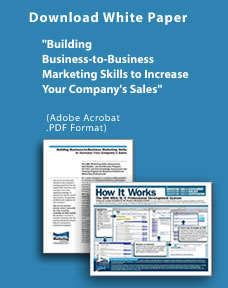
Test, Train, and Build Your B2B Marketing Skills for Better Sales Success: BMA Announces New Assessment, Training, and Certification for B2B Marketing Managers
For more information on the new BMA Marketing Skills Assessment, Skill Building and Certification (MSA/B/C) training and professional development program, visit http://www.businessmarketinginstitute.com