











Tuesday Marketing Notes (Number 13—December 20th, 2005)
A B2B Marketing Newsletter for BMA Members
____________________________________________________________
MAKE SURE YOU CONTINUE TO RECEIVE EACH ISSUE OF TUESDAY MARKETING NOTES—CLICK HERE TO RENEW YOUR FREE SUBSCRIPTION
Tuesday Marketing Notes (Number 13—December 20th, 2005)
A B2B Marketing Newsletter for BMA Members
MAKE SURE YOU CONTINUE TO RECEIVE EACH ISSUE OF TUESDAY MARKETING NOTES—CLICK ON THIS LINK BELOW TO RENEW YOUR FREE SUBSCRIPTION:
http://www.businessmarketinginstitute.com/newsletter.html
(if you’ve already signed up last week at this link above, no need to do so again)
Putting It All Together: Using Real Marketing to Improve an Existing Marketing Program
Part 2: Turning Technical Features into Compelling Benefits
Last week we covered several ways that CompanyX, an IT business selling its products in a crowded marketplace, could reposition itself away from the crowd of every other me-too IT outsourcing operator in the business.
“CompanyY:” A Major Satellite Communications System Provider
This week, we’ll look at another technology company with another marketing challenge: CompanyY is a manufacturer of satellite communication systems, offering its customers the ability to create their own satellite voice and data networks.
CompanyY makes and sells a complete hardware and software system for satellite communications that allows any company, government, or a military operation to create its own global satellite-based communications network, anywhere in the world. Write the check, put your ground stations and routers in place, boot the system, and you’ve got your own global broadband communications network.
What makes the CompanyY system unique from others in this field is that it’s entirely IP (Internet Protocol) based: This means it transmits voice and data the same way bits and bytes are transmitted over the Internet. this allows for efficient, high-quality global transmission of IP-based voice calls over satellite at virtually no cost, once a user has built their network. Its users also get Internet access, data, and video transmission, in a turnkey network, free of wires and cell towers, giving any organization their own global communications system.
This company sells satellite communications hardware and systems to telecom providers, OEMs and resellers, large corporate customers, government, and military markets, including our troops in Iraq, who use CompanyY’s system.
Your Competitors Won’t Stay “Stuck on Stupid,” and Technological Leads Never Last Forever
CompanyY’s products are truly unique, and, for now, CompanyY is beating the pants off of its competitors, who are large, well-known satellite communications companies notorious for being run by engineers with poor marketing skills. CompanyY is also reaping the benefits of its established ties with major telecommunications services, who are aggressively reselling CompanyY systems to its subscriber bases. CompanyY was also recently acquired by a larger tech company, which looks like more good news.
But just because your competitors are clueless marketers today, it doesn’t mean they’ll be this way tomorrow. This can change quickly with a few key personnel changes and some astute marketing moves, so don’t ever count on them staying “stuck on stupid” forever.
Also, if there’s one thing we know about technology companies, we know that technological advantages and barriers to entry never last, so CompanyY’s lead might also evaporate in weeks or months if one of their competitors comes out with a system that does it better, faster, and cheaper.
And, like all tech companies, the gravest threat to CompanyY isn’t the competitor you know, it’s usually the start-up you don’t know that comes out of nowhere, with a world-changing technological advantage that overnight makes CompanyY look like one of its own flat-footed competitors look now.
So CompanyY must constantly look for ways to improve its marketing program, to forcefully present and sell the advantages of its technology as clearly and effectively as possible, and knock down the walls of complexity in its products in the mind of its prospect. This will help CompanyY keep its major reseller partners in the fold, shorten its sales decision cycle for prospects, and capitalize on new sales opportunities as they develop.
CompanyY is a great company, with superior products and a top-notch management and marketing team: Let’s see if there are ways we can help them stay on top, by making their marketing program and deliverables even better.
CompanyY Home Page
For better or worse, a company’s home page is usually an accurate snapshot of the company’s marketing presentation and positioning. Here is CompanyY’s home page (company and product names blacked out to conceal its identity):
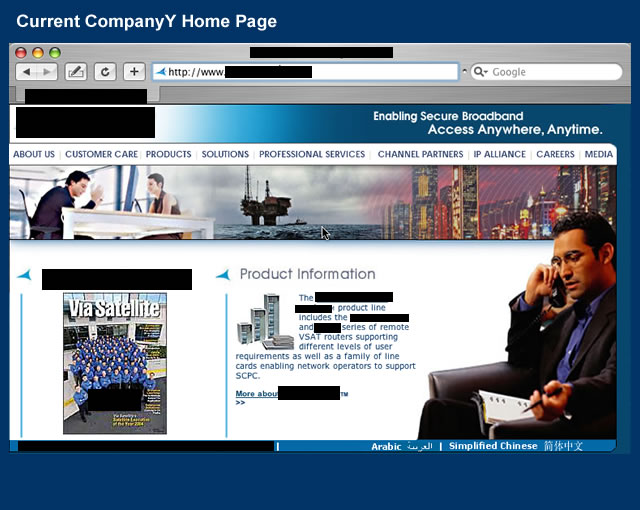
A nice-looking site, with everything in its place. However, there’s not much here that you wouldn’t see on any other Web site for any other company selling satellite gear or broadband communications (the more I look at Web sites for tech companies, the more I realize how they all look the same).
The main space of this site is reserved for the company’s new product announcement:
“The [CompanyY] [product name] product line includes the [ ] series VSAT routers supporting different levels of user requirements as well as a family of line cards enabling network operators to support SCPC.”
—which may be an intelligible, but hardly compelling, statement to engineers, but is far less persuasive or understandable for non-technical readers.
Engineers are People, Too
The main prospect base for expensive, technically complex systems sold to large organizations, like those sold by CompanyY, are usually engineering and other technical professionals. While higher-up non-technical Vice Presidents and CEOs may make the final purchase decision on these products, they’ll do so mostly because their engineering staff tells them which product they think the company should buy.
Just because you’re communicating bit rates, bandwidth efficiency characteristics, and other technical details to these prospects doesn’t mean you can’t make this compelling to these technical readers, and persuasive even to non-technical ones too.
On the job, engineers are driven by the same basic needs as every other B2B prospect: To buy stuff that makes them more productive, and gets the job done faster and better than what they’re using now, or what your competitor is selling. With technical folks, it also helps if your product has interesting and innovative features that serve the major benefits of using the product.
All too often I’ve seen marketing managers and agencies recycle dry technical specifications into the company’s sales materials, without realizing that their technical readers need just as much common-sense justification to buy as non-technical ones do.
Beneath every technical feature, no matter how complicated, there’s a benefit waiting to be pulled out—and your technical reader wants to see it. Your job is to find it, and to ask: “So what’s good about that?” The next step is to translate the answer into sales benefits that are compelling and convincing to your technical reader. And you’ll have to do this over and over again with each new technical feature of your product.
CompanyY Data Sheet
Looking deeper into the site, we see CompanyY has made its full range of product brochures and technical data sheets available for download. A smart move, which already puts CompanyY ahead of many other companies who aren’t doing this yet, but should.
When I look at how a technical company talks about its products, I always start by reading its technical data sheets. Here is where you’ll see how well, or poorly, the company makes the most of explaining its complex technology in terms that also express what’s good and useful about its technology, and why that’s good for the reader. This also helps me to learn about the company’s products from the bottom up, and to discover the hidden benefits waiting to be pulled out from existing copy, with my “new eyes.”
Here is a page from a CompanyY data sheet:
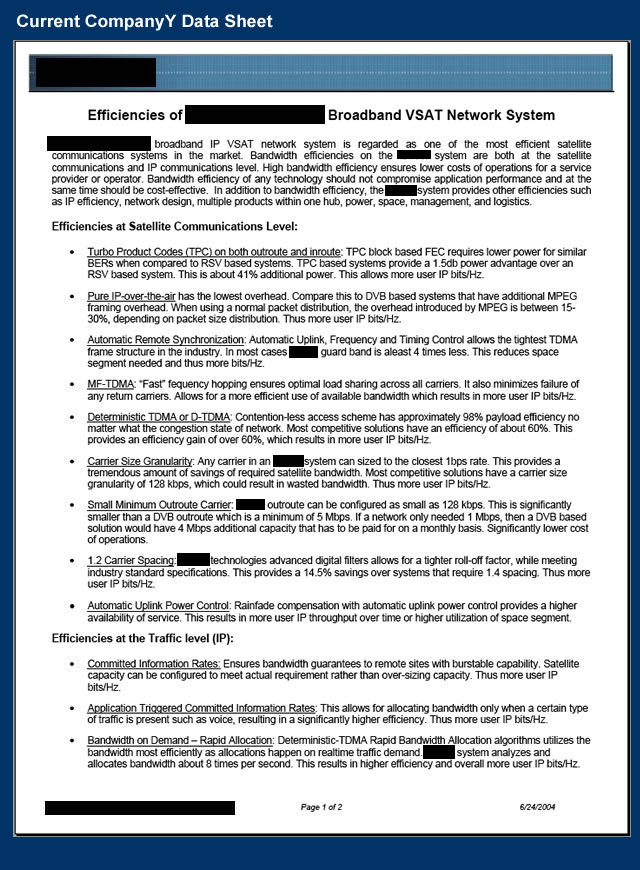
There’s definitely product detail here, but copy in this bullet-point list is a dry recitation of product features and technology. CompanyY needs help in bringing out the benefits buried in these technical points, and telling the reader what each of these benefits means to them.
Let’s start with the first bullet point in the current piece:
“Turbo Product Codes (TPC) on both outroute and inroute: TPC block based FEC requires lower power for similar BERs when compared to RSV based systems. TFC based systems provide a 1.5 db power advantage over an RSV based system. This is about 41% additional power. This allows more user IP bits/Hz.”
As we see on this bullet point, and on every other one, each feature’s true benefit is buried deep within the body of the paragraph. Our job is to find this benefit, bring it out of the copy, and tell the reader how this benefit improves CompanyY’s network system.
Spotting the Buried Benefit
Can you spot the hidden benefit in the paragraph above? Here it is in red below:
“Turbo Product Codes (TPC) on both outroute and inroute: TPC block based FEC requires lower power for similar BERs when compared to RSV based systems. TFC based systems provide a 1.5 db power advantage over an RSV based system. This is about 41% additional power. This allows more user IP bits/Hz.”
Now, we’ll pull this benefit out and lead with it in our newly-rewritten paragraph:
Turbo Product Code (TPC) error-correction boosts power by 41% TPC block-based FEC on both outroute and inroute requires lower power for similar BERs when compared to RSV-based systems. TPC-based systems provide a 1.5 db power advantage over an RSV-based system;
By pulling the hidden benefit out of each bullet point and rewriting the copy to explain why the technical benefit makes CompanyY’s product better, we’ve made these benefits come alive for the technical reader. Putting the main benefit in bold type at the lead of each point also makes it easy for non-technical prospects to skim-read this piece, and to get the gist of CompanyY’s benefits even if they may not fully understand the technology.
This can be done for every bullet point. Here’s how another paragraph from the current data sheet, with the buried benefits in red . . .
“Deterministic TDMA or D-TDMA: Contention-less access scheme has approximately 98% payload efficiency no matter what the congestion state of the network. Most competitive solutions have an efficiency of about 60%. This provides an efficiency gain of over 60%, which results in more user IP bits/Hz.”
—can be rewritten:
98% payload efficiency, vs. only 60% with competitive systems: Contention-free deterministic TDMA or D-TDMA access scheme delivers the industry’s highest payload efficiency, regardless of the network’s congestion state;
As you can see, once you’ve identified the buried technical benefit, you can lead with it and rewrite the paragraph in friendlier language.
Now, we’ll can repeat this process for every single bullet point on this data sheet. Once we’ve done this, we’ve also internalized these benefits and gained enough perspective to go back and rewrite the headline and first paragraph of this original data sheet. Here’s the original sales copy, with the buried benefits in red:
“Efficiencies of CompanyY Broadband VSAT Network System
CompanyY broadband IP VSAT network system is regarded as one of the most efficient satellite communications systems in the market. Bandwidth efficiencies on the CompanyY system are both at the satellite communications and IP communications level. High bandwidth efficiency insures lower costs of operations for a service provider or operator. Bandwidth efficiency of any technology should not compromise application performance and at the same time should be cost-effective. In addition to bandwidth efficiency, the CompanyY system provides other efficiencies such as IP efficiency, network design, multiple products within one hub, space, management, and logistics.”
. . . and here is our re-written headline and lead paragraph for this piece:
Higher bandwidth efficiency means lower operating costs for service providers and operators, but greater efficiency must not compromise application performance.
CompanyY Broadband VSAT Network System gives you the industry’s most efficient satellite communications systems available on the market, without compromising the performance your users demand from your network and their applications.
By finding the buried benefit, bringing it up to the front, and rewriting the copy we’ve condensed CompanyY’s major benefit to a more powerful—and more readable—lead paragraph for the data sheet. We’ve also developed an important core benefit—high efficiency that means lower operating costs, without sacrificing performance to the end user—we can use in many other deliverables.
Data sheet design changes: We also revamped the CompanyY data sheet to bring out these new benefits and generally make the piece more readable:
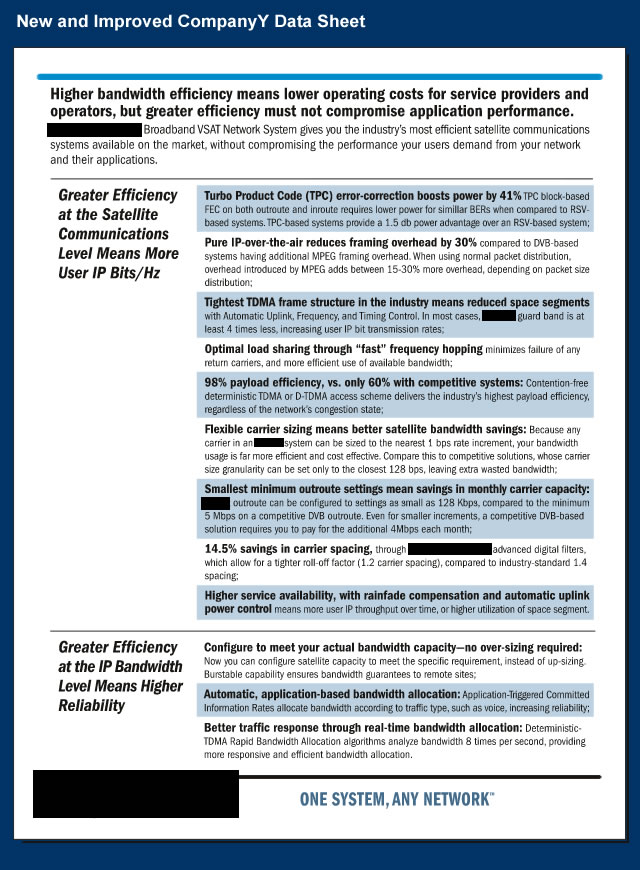
Copy for this new data sheet does a better job of explaining what’s in it for the prospect if they use CompanyY’s system, what the technical reader can expect from these technical benefits in technical performance, and how each of these technical advantages contributes to one of the major benefits of CompanyY’s satellite communications system: Efficiency without compromise.
CompanyY Product Brochure
Now that we’ve wrestled with the many technical benefits of CompanyY’s system, we’re ready to take on their brochure shown below. This is a new product introduction brochure for a system they are selling to major telecom carriers:
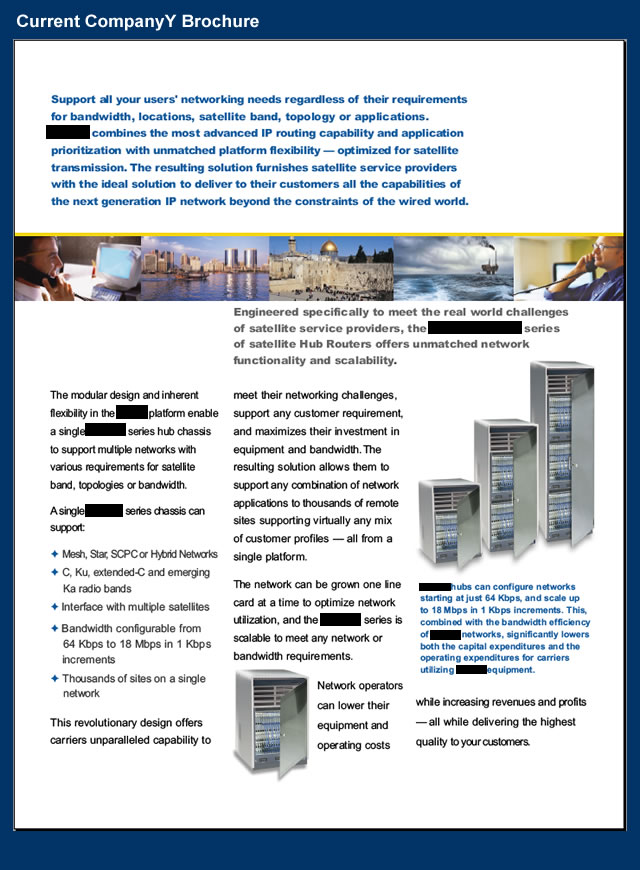
Like most brochures for technical companies, CompanyY’s brochure is written both for technical readers (telecom engineers) and non-technical C-level higher-ups at the major telecom company carriers CompanyY is selling.
They’ve produced a nicely designed, competently written brochure. But can we develop better benefits, and can we make a deliverable for them that’s more effective at communicating the core benefits of CompanyY’s system, as they are seen by their prospect? Let’s see what we can do…
Here’s the lead paragraph in their current brochure:
“Support all your users’ networking needs regardless of their requirements for bandwidth, locations, satellite band, topology or applications.
CompanyY combines the most advanced IP routing capability and application prioritization with unmatched platform flexibility—optimized for satellite transmission. The resulting solution furnishes satellite service providers with the ideal solution to deliver to their customers all the capabilities of the next generation IP network beyond the constraints of the wired world.”
Here we see some promising benefits, but for the lead paragraph in a brochure, we don’t see the knockout benefit we need to pull readers into the copy of the brochure, and to keep them reading.
If you’re selling a turnkey telecom service to executives and technical people at major telecom carriers, what do these guys want? What they ultimately want is to make more money by selling new services to their customers, and what we want to tell them is we can do this better with CompanyY because our system is more flexible, more capable, and more efficient than anyone else’s system.
Here’s a headline that I think delivers the killer benefit that moves the readers of this brochure:
Carriers: Build Profitable New Services for
Your Users, Offer Infinite Networking Options,
and Get the Highest Bandwidth Efficiency
in the Satellite Industry
This new headline hits the three major value propositions CompanyY’s prospects are looking for: To offer profitable new services to users, with infinite service features and options, and to receive the implied cost savings the industry’s most efficient satellite system can deliver.
We’ve re-written the first three paragraphs of the brochure copy to expand on this new headline:
Your customers demand video, VoIP and other cutting edge technologies.
To provide these services at a profit, you’ll need the most efficient, flexible, reliable, and scalable networking options available.
The CompanyY product series gives you the features and technology you need to provide the networking options and services your customers demand today, and grow your network services into the future—with the industry’s most efficient bandwidth utilization available for all IP applications.
This plain-spoken copy speaks to what prospects at these telecom carriers want: To provide profitable new telecommunications services to their customers. And it does this without the marketing buzzwords and disengaged tone of the current brochure.
To emphasize the flexibility of CompanyY’s communications systems to the prospect’s need, we’ve also added an infographic chart, which is an upgraded version of one we noticed in their existing brochure:
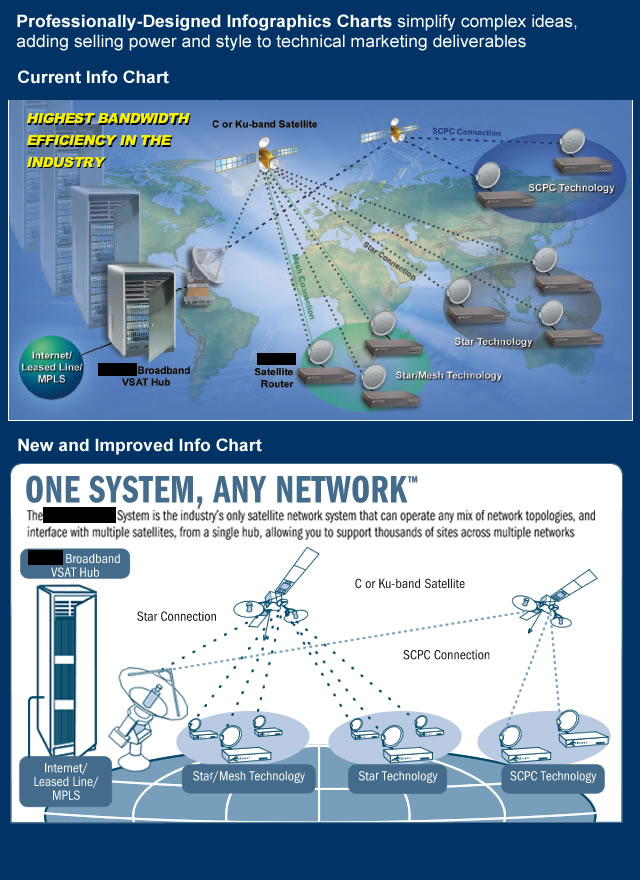
Infographic charts and tables often communicate complex ideas more quickly than sales copy alone, and it’s well worth the $500 or so you’ll have to pay a good designer to have these worked up when you need them, instead of relying on hand-me-down PowerPoint slides drawn up my your company’s engineers, which apparently is what ended up in the current CompanyY brochure.
For the infographic, we’ve also created a new tagline:
One System, Any Network
—to express the concept that the CompanyY system can be configured for any satellite network topology, a strong selling point for CompanyY systems. We’ll use this as a strong positioning tag on other deliverables.
Below is our harder-hitting layout for this brochure:
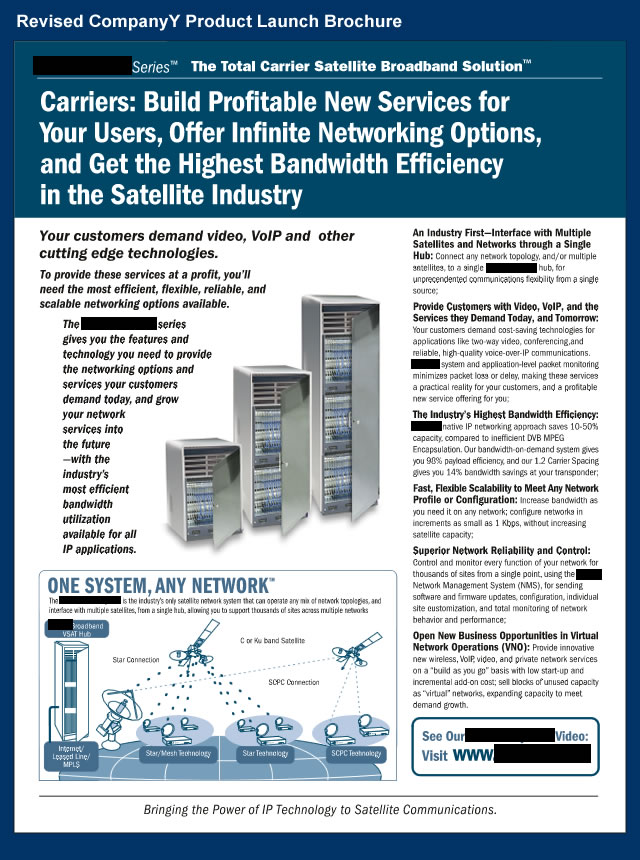
We’ve broken out the body copy on the right into bite-sized paragraphs, each with bold-faced first lines to make it easy for busy skim-readers to get the gist of the key benefits of CompanyY network systems.
The “call to action” box at the bottom of the new brochure layout directs the reader to a series of videos on the CompanyY Web site, which we’ll cover in the next section.
Now, Back to the Web Site . . .
Now that we’ve done the hard work of rewriting CompanyY’s sales copy into harder-hitting benefits that are convincing to their prospects, we can apply what we’ve learned to improve the effectiveness of the CompanyY Web site.
Web Site KNOW and DO
Let’s use the “KNOW and DO” technique (covered in the 11/22/05 issue of TMN) to develop a site navigation layout that gives these kinds of site visitors the information they’re looking for when they access the CompanyY site:
- Interested prospects (end users);
- Prospective partners (resellers of CompanyY systems)
- Current customers
DO links: Here are the things I think these site visitors above would like to DO when they visit the CompanyY site:
- Get more information on CompanyY’s systems;
- Find out how they can partner with CompanyY;
- Get customer service;
- Find out what current customers and users say about CompanyY systems;
- Contact CompanyY for more information
We’ll reduce these “DO” items to 5 tabs across the top of the new CompanyY site:
See Our Story;
Partner With Us;
Support;
What Our Customers Say;
Contact Us
KNOW links: Here are the things I would like site visitors to KNOW about CompanyY and its systems:
- Learn more about CompanyY’s underlying technology;
- Learn more about applications and business opportunities with CompanyY communications systems;
- See profiles of success stories from current partners and users;
- Learn more about CompanyY and its management
- Company news and upcoming events
- Answers to frequently-asked-questions about CompanyY and its technology
—which we’ll reduce to these 6 “KNOW” links:
Our Technology;
Applications and Opportunities;
Success Profiles;
About Our Company;
News and Events;
FAQs
Home Page Sales Content
For the main information area of our new CompanyY home page, we need to massively “amp up” the presentation power of the new product announcement featured on CompanyY’s current site.
To do this, we’re going to use five short Flash videos (with audio narration) to highlight different aspects of the new CompanyY communications systems products:
1.) Main product video intro;
2.) Features overview;
3.) Applications and benefits for corporate (enterprise) users;
4.) Applications and benefits for network operators;
5.) Spotlight: Satellite services for rural applications
I’m a big proponent of using Flash video clips with spoken audio narration as major selling featureson B2B Web sites, and nowhere is this new presentation technology more effective than it is for explaining big, complex systems, such as those sold by CompanyY. For around $10,000, CompanyY can produce these videos, and present and sell its product many times more effectively than with text alone.
Flash video clips don’t have to be elaborate productions: All that’s needed are a slideshow-like series of product photos, diagrams, and (if available) a few live clips, along with—and this is the most important part—narration by a voiceover pro, since the spoken audio part of each clip carries most of the weight of presenting and selling the product.
Here is our final version of CompanyY’s new Web site:
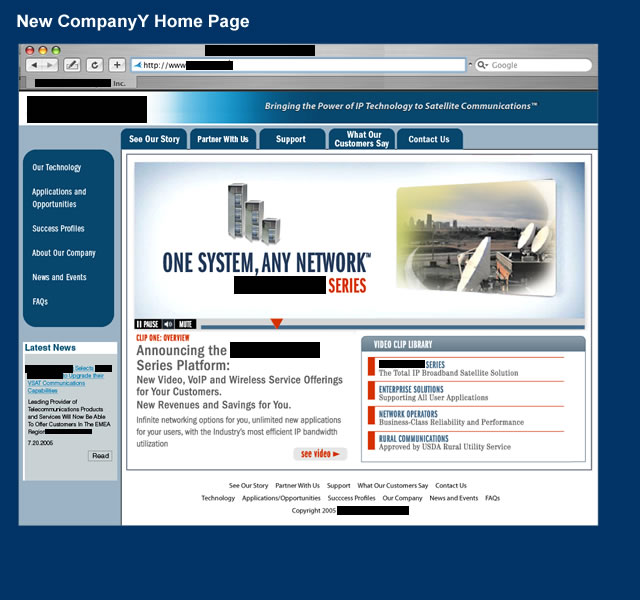
We’ve changed the navigation to reflect the our new site navigation layout, placing our KNOW options on the left sidebar and DO options at the top. We’ve also made the site much more aggressive in its presentation, placing our new tagline, “One System, Any Network,” and strong “New Revenues and Savings for You” sales copy below. Now’s there’s no doubt about what CompanyY is selling, who it’s selling it to, and the benefits for this reader.
A main video player button and sidebar tabs on the right take site visitors to video clips for the main product intro video and the other four clips. A current news ticker on the left displays company news and trade show announcements, and headlines from articles written in trade publications about this company.
Here’s a side-by-side comparison of CompanyY’s current site, and our new version:
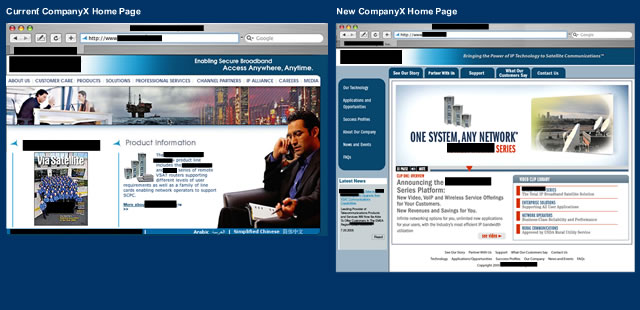
To see a larger, more readable version, click below:
http://www.businessmarketinginstitute.com/images/8-tmn-121305-large.jpg
Our Job is to Discover and Reveal Reasons for Prospects to Buy
Discovering and revealing the technical benefits buried deep in their current deliverables helped us improve the presentation and effectiveness of CompanyY’s marketing deliverables and Web site.
CompanyY is a great company, with a great product. They just needed some help to bring out these benefits buried in their product, and in making the stronger statements about those benefits that prospects would find compelling. Often, this is all most companies need.
If, by presenting their product more clearly and effectively, and using techniques such as Web video to provide site prospects with a clearer, more focused, more effective presentation of its products, CompanyY is able to reduce its sales decision cycle by, let’s say, 25%, then they can make the most of their current system’s technological superiority, and hedge against the day one of their competitors becomes a better marketer. That’s a major, measurable improvement to any marketing program.
As marketing managers, we can’t control our company’s technology, but we can always improve the presentation of our product’s benefits. On the agency side, you can’t expect to know everything about every client’s technology, but you can learn to uncover the universal benefits of productivity, efficiency, savings, and profit that your client doesn’t see as clearly, and which are often buried in the language your client uses to talk about his product. You can do this both by studying the company’s current marketing deliverables, and by listening to the company’s sales reps (more on debriefing sales reps in a future TMN).
By learning these skills, you can discover the benefits that motivate prospects, present these benefits more clearly, and remove the doubt that your marketing deliverables could have made a better case for your company’s product.
Would you like to be a part of an “extreme marketing makeover” for a future issue of TMN? Send me a link to your company’s Web site, and samples of your company’s marketing deliverables, and I’ll review them for a future TMN.
Merry Christmas!
Next week, I’ll show lessons learned from a Jacksonville, FL machinist who, by enthusiasm and “showing what you know,” built a successful business without a Web site or fancy marketing advice . . .
Comments? Suggestions? Send them to me at eric@realmarkets.net
_____________________________________________________________
Eric Gagnon (eric@realmarkets.net), is president of GAA, a sales and business development consulting firm, and is the author of The Marketing Manager’s Handbook, the master study guide for the Business Marketing Association’s Marketing Skills Assessment, Skill Builder, and Certification (MSA/B/C) programs.
For more information on The Marketing Manager’s Handbook, available to BMA members at a special discount, link to:
http://www.businessmarketinginstitute.com/book.html
_____________________________________________________________
Test, Train, and Build Your B2B Marketing Skills for Better Sales Success: BMA Announces New Assessment, Training, and Certification for B2B Marketing Managers
For more information on the new BMA Marketing Skills Assessment, Skill Building and Certification (MSA/B/C) training and professional development program, visit http://www.businessmarketinginstitute.com