










 Tuesday Marketing Notes (Number 12—December 13th, 2005)
A B2B Marketing Newsletter for BMA Members
____________________________________________________________
MAKE SURE YOU CONTINUE TO RECEIVE EACH ISSUE OF TUESDAY MARKETING NOTES—CLICK HERE TO RENEW YOUR FREE SUBSCRIPTION
Putting It All Together: Using Real Marketing to Improve an Existing Marketing Program
Part 1: Positioning Your Company in a Crowded Field
by Eric Gagnon
For the past two months I’ve been covering the techniques of Real Marketing—using clear presentation and effective execution in major marketing deliverables—to improve the sales response of print advertising, Web sites, and sales copy used in every marketing deliverable.
I’ve also covered some important new developments in B2B marketing, such as Web video and white papers, to help you improve the sales response of your company’s (or client’s) Web site and marketing program.
In this issue, and in next week’s TMN, I’ll show you two real-world examples of a before-and-after “extreme makeover” of an existing marketing program for two real-life B2B companies, using these Real Marketing techniques on Web sites and other deliverables to improve their sales response.
I’ll describe where and how the current marketing for these companies falls short, what I think was important for these companies to change, and my new “after” approaches for each company. To protect the innocent in these examples, (companies and their agencies), company and product names have been blacked out.
“CompanyX:” A Leading ASP Provider
This week’s company is “CompanyX,” a leading player in the outsourced messaging, hosting, and ASP (application service provider) services field, whose market focus is on SMBs (small and mid-sized businesses).
Background: ASPs help companies outsource many of their IT operations, such as e-mail hosting, backoffice database applications, and other software applications. ASPs sell these applications as services that can be “rented” for each user, instead of being bought, installed, and maintained by the company itself, which is the way software has customarily been sold to and used by corporate customers.
ASP companies were hot during the peak of the dot-com era five years ago, but many failed, because they suffered from a lack of focus and inability to build a solid business case for outsourcing a company’s major IT operations.
Some ASPs, like CompanyX, survived this shakeout partly by specializing in certain applications and markets—in its case, by providing online collaboration (i.e., project management communications), software services and messaging applications, such as Microsoft SharePoint, to small to mid-sized businesses. But they’re still fighting against many other ASP competitors in what’s becoming a commodity business.
The key to CompanyX’s survival and success is to uniquely position itself to its prospects with a sales message that is effective in getting prospects at small to mid-sized companies to respond—that is, to contact the company and take a step closer to buying.
Current Web Site
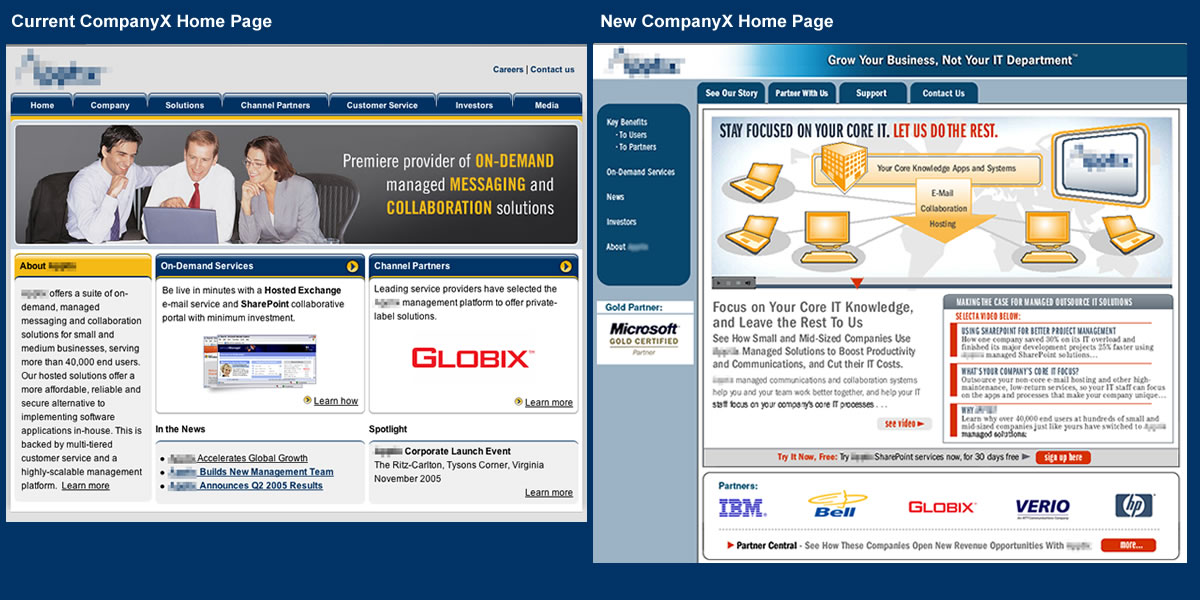
Here’s a look at CompanyX’s current home page (to see a larger, more readable version, click here):
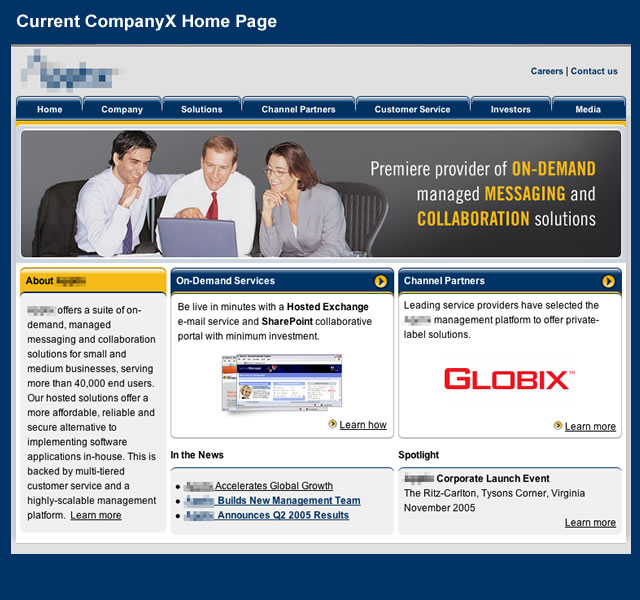
A competent site, for sure, but there’s nothing here to distinguish or position CompanyX away from every other ASP company—and there are lots of them out there.
Overall, there are two major problems with the site:
- Weak presentation: The site doesn’t clearly, instantaneously tell viewers what they can DO with CompanyX’s services, nor does it instantaneously communicate the unique key benefits of, and uses for, CompanyX services. Worse yet, sales copy on the site is a recitation of the same tired IT marketing buzz-phrases (“premiere provider,” “multi-tiered”) seen on every other IT Web site;
- Weak positioning: The site doesn’t assertively pull users through a coherent presentation of the real-world benefits of using CompanyX services, addressed to the kinds of prospects CompanyX is trying to reach, using the sales benefits that are important to these prospects.
Talk to Non-Technical Decision-Makers Using Non-Technical Language
CompanyX is selling its services to small to mid-sized businesses, where the key decision-maker is usually the non-technical owner or CEO of the company, and not the IT manager (and most small businesses aren’t big enough to have an IT manager).
So, right from the start, CompanyX isn’t speaking in the same non-technical language of the key purchasing decision maker for its services, which reduces the effectiveness of its presentation. If CompanyX talks about its services in a way that convinces the owner of the company to buy, his computer guy (if he has one) will follow.
Dump the jargon: So, the first thing we do is strip out all the copy and start talking about this company’s product in plain English, using business benefits that any non-technical business owner or executive could understand. We’ll put technical details as needed further down in the site.
Focus on What’s Good for the Prospect, Not Theoretical Benefits
One of the key pieces of information we discovered while researching the ASP market was that every company has its own, proprietary applications that are critical to running its operations, and some of these apps give this company its competitive advantage. These would include internal customer and prospect databases, or software systems governing proprietary manufacturing floor operations or processes.
Think about it: Would you remove your own company’s internal customer and prospect databases and put them on someone else’s server, away from your direct possession and control? How about your accounting data? Or your own proprietary programs and files? Neither would most business owners; these are the family jewels of any business.
These proprietary applications and data are a critically important company asset, and they’re usually far too important to farm out to a service provider, regardless of the savings involved. At least, that’s the perception of the company owner or manager. So why are most ASP companies, including CompanyX, making the same blanket pitch to outsource more or less all of a company’s IT operations?
Far better to make the business case for outsourcing the company’s lower-order applications that drain time and resources, such as e-mail hosting and low-end back office operations, to free up a company so its staff can stay focused on the proprietary IT applications that it knows and does best, and that give the company its unique competitive advantage.
This fact gives us a major unique benefit for CompanyX, which we can sum up in this promotional and positioning tagline:
Stay Focused on Your Core IT. Let Us Do the Rest.
—where “Core IT” are the proprietary set of IT applications that give the company its reason to be, and its competitive edge, and “the rest” are the low-end IT applications most companies find to be a costly drag on their IT staff’s productivity: E-mail hosting, file transfer, software upgrades, etc.
Next, we expand this main benefit statement with additional supporting sales copy:
Focus on Your Core IT Knowledge, and Leave the Rest to Us
See How Small and Mid-Sized Companies Use CompanyX Managed Solutions to Boost Productivity and Communications, and Cut their IT Costs.
We also discovered this little gem buried deep in the text of the existing site:
Grow Your Business. Not Your IT Department.
Wow! This will hit home with anyone who’s ever owned or run a business, and for business owners it’s as solid a selling proposition as you can get. How could these guys have missed this one? We’re going to feature this as a new copy tagline prominently on every new deliverable.
Now we have the two major elements we need to begin work on marketing deliverables: A clear image of who are prospect is (small and mid-sized business owners), and a few clear benefits that uniquely position CompanyX’s services in a way that’s meaningful to these prospects; now we can build on this in all deliverables.
We’ll begin with the Web site, and then develop other ways to drive prospects there.
Web Site: KNOW and DO
The first step is to set up the new site’s navigation, to focus on the three major kinds of individuals who will visit this site:
• Non-technical, small and mid-sized business owners;
• Prospective large corporate resellers (partners);
• Exisiting CompanyX customers
DO links: Utilizing the “KNOW and DO” technique (covered in the 11/22/05 issue of TMN), here are the four things these site visitors would want to DO when they visit the CompanyX site:
See Our Story: First, site visitors who are prospects want to see a quick overview of CompanyX’s services;
Partner With Us: Next, site visitors from potential corporate partners—i.e., big technology service companies (like current partners IBM, HP, etc.) want to get right to the information they need to see on how they can resell CompanyX services to their markets;
Support: Existing CompanyX customers will want to visit the site for customer service;
Contact Us: Interested site visitors will want to contact the company to get more information on CompanyX products.
KNOW links: Here are the five things we want site visitors to KNOW about CompanyX:
We’ll plug these KNOW and DO options as links across the top and left-hand sides of our new site, each linking to new content areas for the site. Next, we’ll develop the main content for our new site’s home page.Key benefits: To users and partners;
On-demand services: Basic product and service descriptions for ASP and other outsourced IT services;
News: Company press releases;
Investors: News and info for investors;
About CompanyX: Company background and executive team
Web Site Main Information Area: Copy and Web Video
For the main area on our new home page, we’re going to use bold text headlines and Web videos to let site visitors know what CompanyX does, and tell them what’s good about this, in plain English, not IT techspeak.
The copy headlines we’ve just developed for the new site strongly positions CompanyX’s unique selling point, and this benefit’s advantage to small and mid-sized business owners.
Web video: To communicate this information rapidly and expertly to sales prospects, we will add five short Flash videos on the CompanyX home page. Each of these 1-2 minute video clips (each with an audio voiceover) would cover the main benefits of the key features of CompanyX services:
• Main video presentation: A promotional overview clip: “Focus on your core IT knowledge, and leave the rest to us;”
Supporting video clips:
• “Using SharePoint for better project management:” Highlighting the benefits of increased productivity with CompanyX’s Microsoft Sharepoint implementation services, another major CompanyX service offering;
• “What’s your company’s core IT focus?” Another video presentation focusing on the business case for using CompanyX services to make IT operations more productive for small and mid-sized business owners;
• “Why CompanyX?” Why a site visitor or prospective corporate reseller should go with CompanyX instead of another ASP
Why lead the home page with video? Why not use regular sales copy like everyone else? The spoken word, accompanied by supporting images, is a far more powerful selling tool than text alone. Also, if our site visitor sees (and hears) our video, we then know we’ve reliably delivered an effective, consistent sales presentation to that visitor—as opposed to just hoping they’ll read our sales copy; and our best chance of getting a site visitor to click on any of these video clips is to put them right up there on our home page. Since video can now be embedded in Web pages and played by over 90% of our market, we’re confident that site visitors can see and hear our clips.
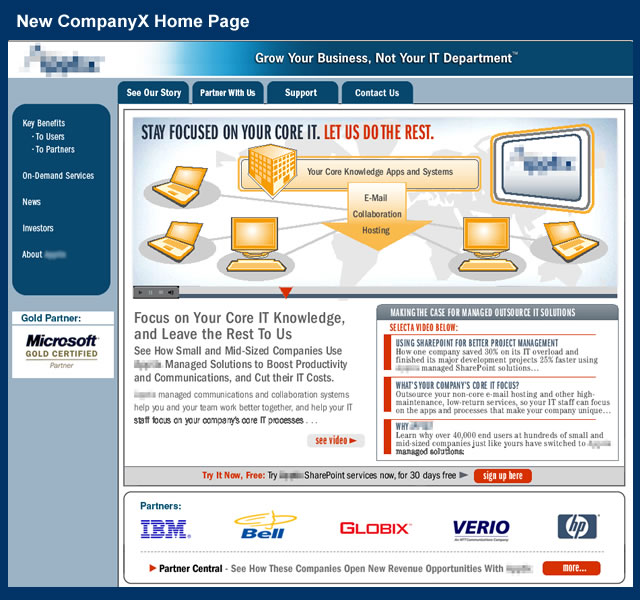
Here is our new version of the CompanyX site (to see a larger, more readable version, click here):
—and here it is placed alongside the current site (to see a larger, more readable version, click here):
Fractional Print Advertising Program
If you’re in what’s becoming a commodity business (outsourced IT services) you can’t rely on Google searches and IT guys to find your site online. Especially if you’re selling to owners and top execs at small and mid-sized businesses. Let’s face it, these guys aren’t likely to be surfing the Net for technical services. So you’ve got to get to them by reaching them in the media they see, which means using print advertising in business publications that sells CompanyX services from their point of view.
I’m not talking about some puffy, expensive “brand image” campaign. Instead, we’ll use targeted, fractional strip ads in general business and IT-related publications, to drive prospects from print to the new CompanyX Web site.
Additionally, many larger companies in this “small and medium” size business market do have their own IT staffs, so we’ll split off half of our print advertising to address IT managers at these firms, by advertising in IT-related publications.
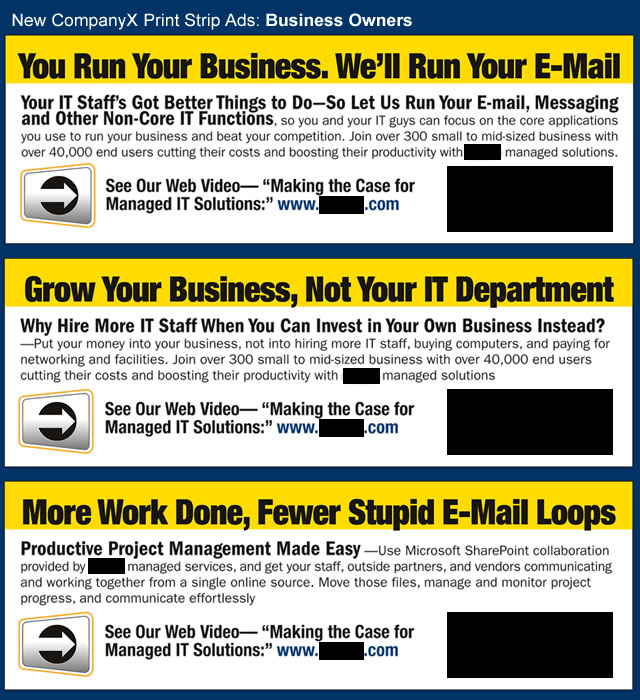
Business market ads: Here are three strip ads we’ve produced to reach non-technical business owners, to run in general business publications (such as Inc., Business Week, Forbes, Fortune):
IT market ads: Here are three ads we’ve produced for IT professionals at small and mid-sized firms, to run in IT pubs (CIO, InfoWorld, Computerworld, etc.):
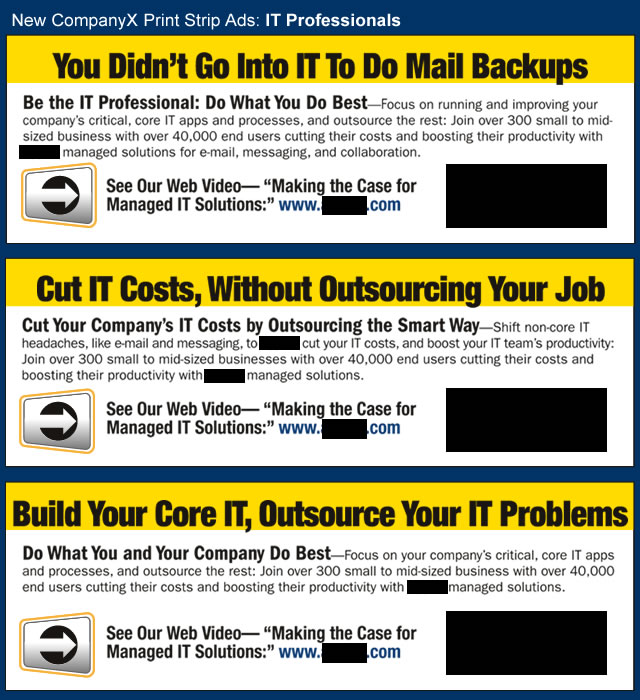
Headlines and sales copy for each group of ads are targeted to each of these two audiences, using benefits focused on the individual, specific needs and wants of small business owners, and IT managers.
Placement: Ads are set to run in threes; with each ad running on a page on three sequential pages in the publication. This sequential placement provides greater impact for these ads than one-time placement of a larger ad.
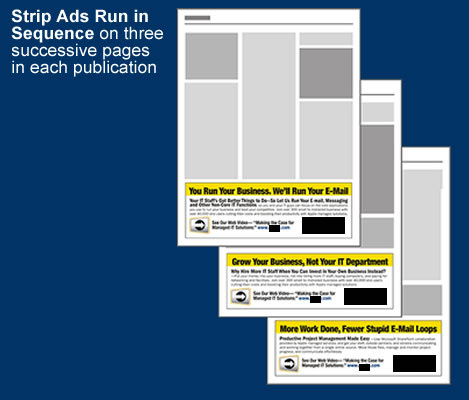
Linking print to the Web: The main goal of these ads is to drive readers from the ad in print to the video on the CompanyX site, using taglines at the bottom of each of these ads to link interested readers to Flash videos on the CompanyX Web site. Here’s where we’ll draw interested prospects to the CompanyX site, where our Web video gives them a clear, compelling presentation to move them to contact the company.
“Success Stories” White Papers
As I’ve already mentioned, I believe CompanyX’s current Web site copy and deliverables fail to communicate the real-world business and productivity benefits of using their services.
By this I mean the hard reasons why it’s better for a small to mid-sized business owner to offload some of their IT operations to CompanyX, or to use CompanyX SharePoint collaboration software for project management.
Like every other tech company choking on its own jargon, CompanyX doesn’t really explain what a real company can do with these systems, or how using collaboration software improves productivity and reduces expense, in real-world terms.
To address this problem, the third major element of our makeover are white papers documenting the savings and productivity gains experienced by current CompanyX customers. To improve chances for sales success even further, these white papers can be further specialized by industries targeted by CompanyX, to make these “product stories” even more highly relevant to CompanyX prospects in those industries.
We developed a prototype of a “Success Story” white paper, which would document the actual experiences and measurable results of current CompanyX customers:
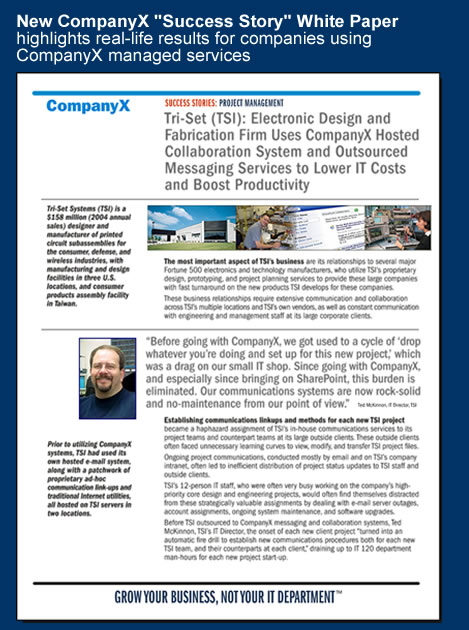
A link to a .PDF of this white paper prototype is here.
This white paper prototype uses a case study editorial format, with quotes from actual CompanyX customers and end-users, explaining how they use CompanyX services, and the results they’re receiving from using these services. Hard numbers would also be used to document actual savings and productivity gains from outsourcing to CompanyX services.
By using white papers to communicate the true experiences of actual customers, and the documented improvements in their operations, CompanyX goes a long way to shortening its sales cycle and setting itself apart from every other look-alike ASP.
Moving With the Herd is Riskier in the Long Run
One of the dangers of working in crowded IT businesses—or any other business—is developing a herd mentality. From the marketing perspective, it’s always safer and easier to market your products the same way everyone else in your field is doing it, talking to the same prospects everyone else is talking to and wrapping your product benefits in the familiar marketing techspeak everyone else is using.
In a crowded business, failing to distinctly position your company in your market invites failure. Playing it safe by positioning and marketing your product the same way your competitors do fails to give prospects a reason to buy from you, and not from them. Worse, in technology marketing, “doing it like everyone else” allows anyone who is bolder and more innovative than you to jump ahead.
By moving CompanyX away from their tired, generic technical IT marketing approach, and toward serving the needs and wants of the non-technical prospects who actually make the purchase decisions in a small or medium sized company, and by getting more aggressive about marketing to these prospects in their language, using clear presentation, CompanyX has a chance to move ahead of the pack, shorten its selling cycle, and break open new sales opportunities before anyone else.
Is this a risky move for CompanyX? Yes, but there’s always opportunity in risk: The mere fact that you are out there doing something new will always lead you to new ideas and approaches you’d never see if you played it safe. Using fast, effective execution in your marketing program means you can always capitalize on these new opportunities.
As a marketing professional, risk is your business: Taking intelligent risks based on common sense is the only way to insure the long-term success of your company, or your client.
Now, Tell Me What You Think . . .
Now that I’ve shown you my take on CompanyX’s situation, I’d like to throw it open to all you marketing pros out there.
Do some research on the ASP market, see what other companies are doing out there in the ASP business, and tell me if you think I’m right or wrong in my approach. E-mail me at eric@realmarkets.net and I’ll list your comments in next week’s TMN.
Next week, we’ll cover another marketing assessment with “Company Y,” illustrating how strong, distinctive positioning and turning technical features into benefits can improve a company’s marketing program . . .
Postscript:
In last week’s TMN on white papers, we featured an example of Menlo Innovations’ use of AdWords keyword search ads linked to white papers.
Richard Sheridan (rsheridan@menloinnovations.com), Menlo’s president, wrote to mention that“The e-mails are part of an automated campaign, but the e-mails come from my e-mail address which means if someone happens to hit ‘reply’ the reply comes to my e-mail box. Thus, suddenly and effortlessly we go from automated to personal interaction. Very powerful.”
Thanks Rich for pointing this out!
Reader Comments from Last Week’s TMN:
Responding to last week’s TMN on white papers, Mike O’Sullivan (mike@mikeos.com) writes:
Hi Eric,
Excellent article today (and excellent articles always).
I do have a quibble, though. In today's article you talk of how white papers are "anti-brochures" and say this...
>>"Where a brochure starts with your product's benefits, a white paper starts with your reader's fears, concerns, doubt, or other motivator to establish empathy with the reader, and then introduces your product in a sincere and objective way as the solution to their problem, using facts and adding hard data to prove its point."<<
A good brochure -- or any other good marketing piece -- *should* "start with your reader's fears, concerns, doubt, or other motivator to establish empathy with the reader." If it doesn't, if it's full of "hack marketing copy" as you put it, then that's the fault of the company producing it, not the fault of the medium. If you have something truly valuable to say, something that clearly identifies with your reader, there's a good chance people will read it!
[ That is not to say that if you have good brochures you don't need white papers -- white papers allow you to speak about your key topics (correction, your *prospect's* key topics!) in much greater depth. ] …
Mike O'Sullivan
Marketing Writer
http://www.mikeos.com
Dear Mike:
You make an excellent point on the comparison of white papers to brochures.
I should have clarified this statement to stress that many marketers who write copy for the same product day after day run the risk of getting stale. This means they’ll fall into the trap of regurgitating tired-sounding sales copy benefit boilerplate into their brochures and other marketing deliverables, instead of starting from the reader’s point of view. As marketers, white papers give us the opportunity to break this pattern and make a clean start. Thanks for bringing up this point.
P.S.: Mike has also writtten an excellent article on the topic of copywriting:
"Effective Marketing Copy: It's Not Just About Benefits:"
Comments? Suggestions? Send them to me at eric@realmarkets.net
_____________________________________________________________
Eric Gagnon (eric@realmarkets.net), is president of GAA, a sales and business development consulting firm, and is the author of The Marketing Manager’s Handbook, the master study guide for the Business Marketing Association’s Marketing Skills Assessment, Skill Builder, and Certification (MSA/B/C) programs.
For more information on The Marketing Manager’s Handbook, available to BMA members at a special discount, link to:
http://www.businessmarketinginstitute.com/book.html
_____________________________________________________________
Test, Train, and Build Your B2B Marketing Skills for Better Sales Success: BMA Announces New Assessment, Training, and Certification for B2B Marketing Managers
For more information on the new BMA Marketing Skills Assessment, Skill Building and Certification (MSA/B/C) training and professional development program, visit http://www.businessmarketinginstitute.com