










 Tuesday Marketing Notes (Number 6—November 1st, 2005)
A B2B Marketing Newsletter for BMA Members
____________________________________________________________
B2B Direct Mail: Don’t Forget the Fundamentals (Part 1)
by Eric Gagnon
It’s a fact: Direct mail is the workhorse of every B2B marketing program. Whether you work in a small or a large company, I’m betting you probably spend a fair amount of your time, energy, and resources on direct mail projects—follow-up mailings to prospect inquiries, promotional mailings to customers, mailings to trade show prospect inquiries, etc.
Wherever you have a mailing list of interested potential prospects and a promotion to offer to them, there’s a potentially profitable direct mail project waiting to happen.
Like any advertising program or any other marketing project, direct mail requires attention to a few fundamental principles that, when followed, dramatically increase the chance for success of your next direct mail project.
But even experienced marketing pros will, due to time pressure or heavy workloads, tend to miss one or more of these key fundamentals in their direct mail projects.
Like a seasoned golfer who occasionally forgets their grip, foot placement, or arm position and winds up in the rough, leaving out any one of these fundamentals in a direct mail project can mean all the difference between a mailing that pulls solid inquiries and orders, or a costly failure.
If you follow these basic guidelines, you’ll go a long way toward insuring the best possible chance for success for every one of your direct mail projects.
The Mailing List
The mailing list is the most important part of any direct mail project. And every successful mailing begins with a good mailing list. Often, however, the mailing list is the last thing many marketing managers consider when producing a direct mail project. Instead, they tend to focus on the exciting stuff, like a great new layout for a mailing piece, or the design of their new product brochure, and they’ll leave list compilation or selection decisions for the end of the project. That’s a big mistake.
A poorly targeted mailing list is the main cause of most failed direct mail projects. So start out every mailing project the right way, by focusing on developing the very best mailing list your project, and then creating the best mailing piece to target these potential prospects.
The Best Mailing Lists are the Ones You Build Yourself
By far, the best mailing lists are “self-compiled”—the lists of prospects and buyers you create yourself, from your own knowledge of your business, industry, and market.
Self-compiled mailing lists include, for example, your company’s inquiry lists from print advertising campaigns, phone, mail, and e-mail catalog requests, and prospect inquiries from recent trade show appearances by your company.
In addition to these list sources, some of the most profitable self-compiled mailing lists are those you build from diligent, do-it yourself efforts. For example, when entering a new market, or executing a focused direct mail project to specific types of potential buyers, by job title or function, the best way to build mailing lists is to do it the hard way: By manually canvassing your marketplace, and gathering exact buyer contact information from all the companies in your market. There’s no better way to get the best-pulling mailing lists available to your company than by building them yourself.
Start the proces of creating your targeted, self-compiled mailing lists by combing through public sources, like trade association member directories, Web sites, and industry directories, as well as your own company’s prospect databases.
Self-compiled lists are usually developed as a result of laborious, time-consuming, detailed research and telephone contact. In most companies this difficult and tedious job always seems to fall on the shoulders of the marketing manager—that would be you.
However, since these lists are likely to provide your biggest payoff in sales response, it’s well worth your time and effort to build them; I’ll discuss a few effective ways to get this done.
Self-Compiled Mailing List Sources
You can tap the following sources to develop self-compiled prospect mailing lists for your company:
Your company’s prospect databases: Obviously, your company’s own internal prospect and sales inquiry database is obviously your first, best choice for generating high-quality lists for your mailing. These include your company’s main customer database, sales prospect contact management system database, and other sources, such as prospects who’ve recently responded to your company’s advertising in trade publications, or prospect names gathered during your company’s recent trade show appearances;
Trade associations: Many trade associations, serving the industries in the markets you’re trying to reach, freely publish their entire member directories on their Web sites, or make them available at a modest additional cost when you order the association’s annual print directory. Trade association membership directories are a valuable starting point for developing mailing lists for test mailings to new markets, or building new lists for a new product launch or a start-up. You can get more information on member list availability by calling a trade association’s own research department;
The Internet: The Internet is the best thing that’s happened to information research since the invention of the printing press. Google is a wonderful list-building tool: Enter the keywords of the companies and industries you’re searching, and Google will take you to the most relevant Web sites. You can usually find the names of a company’s top managers at the company’s own Web site, under “About our Company” links marked “Corporate Profile,” or “Management,” to get the names of prospects to add to your self-compiled mailing lists.
The “Dumb Assistant” List Compiling Method
Like any other marketing method, direct mail is most effective when it’s targeted to the person most likely to be a buyer of your product. And finding these specific individuals at the companies you’re trying to reach should always be the goal of your list-building projects. A very effective technique for getting targeted names for your self-compiled lists is the “Dumb Assistant” method.
Here’s how it works: Have your assistant, a temp, or some other person in your company call the main numbers at the companies you’re trying to reach on your mailing list. Once they reach someone at the reception desk who answers the phone, have them say something like this:
“I’ve been asked to send materials to someone who handles engineering and technology [or any other generalized function] at your company, and I just don’t know who to talk to. Could you please connect me to someone in that department at your company?”
—your staffer will then be connected to an administrative assistant or some other lower-level employee in that department at the company. Once connected there, your staffer should then ask that person this more specific question:
“I don’t know if you’re the right person I should be speaking to about this, but I’ve been asked to send some information to someone in your company who handles airframe quality control [put your own company’s own, very specific product application area here]—could you tell me who that person would be?”
It may take your staffer three or four turns to get the name, phone number and address of the right person in the company, but once this contact is obtained, it’s an extremely valuable addition to your company’s self-compiled prospect mailing list and, by far, is the best way to build a list of highly-targeted, qualified prospects for your direct mail projects. This list will become your company’s most valuable mailing list, forming the core of your direct mail effort.
Because the people at these companies who are being called are being asked for help by your caller, they’ll be more cooperative than if they were being approached by the average, bothersome sales rep.
Think this is too arduous a task for your marketing effort? A group of four or five reasonably intelligent temps can gather about 250 contact names a day. With just two weeks’ diligent effort, you can compile a solid, fresh, high-yielding prospect list of 2,500 names for your direct mail projects, creating a list that’s better than any list you could ever rent from a mailing list broker. I know, because I’ve seen it done, and I’ve seen it take smart companies from nowhere to multi-million dollar sales levels inside of a year. Worth the effort? You bet!
What about voice mail? Bypassing company voice mail systems: Automated voice mail can prevent you from reaching a real live human being at companies today. If your “dumb assistant” hits a “voice mail receptionist” at the company’s main number, use WHOIS on the Internet to reach a real, live person inside the company.
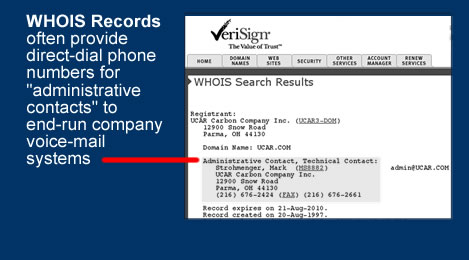
Internet domain WHOIS: Click on the WHOIS link at the bottom of the home page at www.networksolutions.com and enter the Internet domain for the company you’re trying to reach. WHOIS is an Internet feature that gives you full contact information on the people responsible for administering an Internet “.com” Web address at a company.
These records on WHOIS usually list an “administrative contact,” and this person’s direct-dial phone number. This number usually bypasses the automated voice mail systems currently used in many companies, and puts you in touch with a “back-office computer guy” who can refer you to the right person or department you’re looking for in his company.
Company press contacts: Another useful technique for getting the right contacts for your company’s self-compiled prospect mailing lists is to call the published media contact listed at the bottom of a company’s press release in its “News” or “Press releases” link on the company’s own Web site. If your “dumb assistant” sounds like a befuddled executive secretary, and not a salesperson, PR people will be very helpful, and they will often provide them with the contact name you need.
Self-compiling your company’s own prospect mailing lists is laborious and time-consuming, but there’s no better way to create your company’s own mailing lists of the most highly-qualified sales prospects to use in your direct mail projects. And by far, it’s the best way to compile your own mailing lists of targeted prospects, and better than renting “compiled” mailing lists from an outside broker.
In the Part 2 next week, I’ll tell you the truth about rented mailing lists, the winning elements of every direct mail project, and other important fundamentals of B2B direct mail…
Reader Comments from Last Week’s Tuesday Marketing Notes
Responding to last week’s TMN on the creating fractional print ads, Ron Zywicki (rzywicki@davidjamesgroup.com) writes:
Eric:
I appreciated your article in the October 25th BMA Marketing Notes regarding “Ugly” little ads. While I agree with you that small ads can pull better, I find a bit of a flaw in your argument as you’ve made it. I would point out that it’s not necessarily the size that makes the ads work harder; it’s a clear message that communicates the single most important promise of what it is the advertiser is trying to get across.
Thus, I would like to have seen a comment that said the points you were making in terms of copy, layout and messaging are transferable to full-page ads as well. I see far too many ads—big and small—that try to say so much that they don’t say anything. Finally, even with a small size and copy-driven layout, there is never a reason an ad has to be “ugly.” That’s what talented designers are for.
Sincerely,
Ron Zywicki
Creative Director
David James Group
Dear Ron:
Yes, you’re correct that the techniques used to “amp up” the effectiveness of fractional ads work just as well on full page ads—it’s really a matter of having more space to work with, which is always a good thing.
However, the point of my article wasn’t to advocate running “ugly” ads, but to stress that the key selling content of an ad is always more important than how well the ad is designed.
Today, it seems marketing managers are paying more attention to design, and not enough attention to the selling power of their ads. An “ugly” ad with clearly-stated product benefits that sells is always better than an ad whose selling power has been weakened by poor design choices. Here, it’s up to the designer of this ad to make smart choices that enhance its clarity and boldness within the limitations of the smaller space.
If it comes down to a choice between a grungy, hard-working ad that more than pays for itself by the sales leads it pulls month after month, or an untested, prettier one that’s not as bold or compelling, I’ll stick with the “ugly” ad every time!
Comments? Suggestions? Send them to me at eric@realmarkets.net
_____________________________________________________________
Eric Gagnon (eric@realmarkets.net), is president of GAA, a sales and business development consulting firm, and is the author of The Marketing Manager’s Handbook, the master study guide for the Business Marketing Association’s Marketing Skills Assessment, Skill Builder, and Certification (MSA/B/C) programs.
For more information on The Marketing Manager’s Handbook, available to BMA members at a special discount, link to:
http://www.businessmarketinginstitute.com/book.html
_____________________________________________________________
Test, Train, and Build Your B2B Marketing Skills for Better Sales Success: BMA Announces New Assessment, Training, and Certification for B2B Marketing Managers
For more information on the new BMA Marketing Skills Assessment, Skill Building and Certification (MSA/B/C) training and professional development program, visit http://www.businessmarketinginstitute.com