










 Tuesday Marketing Notes (Number 4—October 18th, 2005)
A B2B Marketing Newsletter for BMA Members
____________________________________________________________
All You Need to Know About Advertising Design and Layout
by Eric Gagnon
Advertising design and layout plays an important role in the impression created by your company, and most important, in the presentation of your product’s essential sales benefits and product features.
However, past a certain point, how well an ad is designed has very little to do with its power to actually sell your product. Some marketing managers spend way too much time fiddling with the design of their marketing deliverables, and not enough time focusing on whether or not the design of an ad or brochure communicates the vital information necessary for readers to make purchase decisions on their products.
Good design is clear communication, and in B2B marketing, design must serve the clear and forceful communication of your product’s benefits, features, and applications to your reader—not distract your reader from your sales message.
Here are some basic design rules that will help you, as a marketing manager, add value to the process of designing your ads, brochures, Web pages, and any other marketing deliverables.
Focus on What You Say, Not How You Say It
What the essential elements of your ad, brochure, Web page or other marketing deliverable say about your product, and the reasons why your reader should buy it, are more important than whether or not your headline was set in 24 point Helvetica or 20 point Futura, whether reverse type boxes are set as light blue or darker blue, or if some dork in the next cubicle thinks your ad layout looks “too busy.”
What you say is more important than how you say it: Small, hard-to-read headlines, body text made too small to create more white space, and other bad design decisions obscure the key sales messages of your company’s product, and make it hard for busy readers to learn about your product and what it can do for them.
In marketing, the purpose of good design is to amplify and clarify communication: To make things easy for your readers by making the facts about your product easy to learn and understand. This is especially true in B2B markets, where products are often complicated, and require extensive explanation.
So don’t let design get in the way of your prospect’s need to understand your product.
White Space is Nice, But Black Space Does the Selling
Does the content of your layout—text, illustrations, photos and graphics, communicate the essential information and benefits your prospects want to know about your product? Or, does it leave important questions unanswered?
Which is more effective, long copy or short copy? Long copy is generally more effective in B2B marketing, especially so for complex, technically-oriented products. And interested prospects will read your long copy if it answers the questions they are most likely to ask about your product.
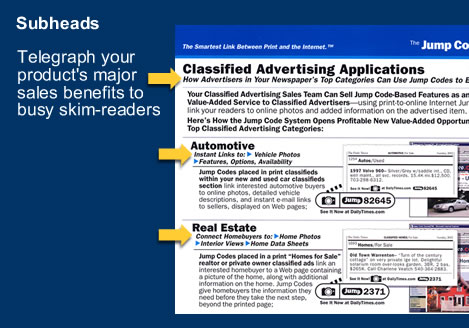
If you use bold-faced subheads spread throughout long body copy, you can also quickly telegraph your product’s key features and benefits to readers who are too busy to read the entire text of your ad, so your ad communicates both to busy readers (that’s most people), and to those who stop to read every word.
The basic rule of thumb on copy length is: Write as much (or as little) copy as necessary to tell your product’s story, answering the most likely questions your reader would have about your product, and make your copy as interesting, readable, and informative as possible.
If you end up with long copy, then add in plenty of subheads and make it fit: Your prospects will read it, if it answers their questions.
No ad, Web page, or brochure ever failed because it gave too much information, but many deliverables generate poor response because they didn’t include enough facts that readers wanted to know about the product.
Where is Your Phone Number and Web Address?
Before you approve any print layout, tape it to the wall, close your eyes, walk backward three paces, then open your eyes: If you can’t read your company’s phone number and Web address on the ad, then it’s too small. Make it bigger, and bolder.
Tell ‘em what to do next! After you’ve told them about your product and its benefits, all your prospect wants is for you to make it easy for them to take the next step. So make it clear how they can contact you on the Web, or by phone.
Clarity-at-three-paces also applies to any other critical sales close information you want readers to see in your ads: Special “order now” sales price offers, sales rep or distributor contact info, or your trade show booth number at the show. Make it readable, even if you have to overrule your ad agency’s art director.
One more thing: If your ad, brochure, or flyer is promoting your company’s next trade show appearance, make sure your company’s booth number, trade show name, and date are featured prominently in the piece. You’d be surprised at how often this essential information for readers is buried in layouts, or forgotten.
Learn to See With “New Eyes”
As a marketing manager, you serve as the stand-in for your company’s potential buyers, prospects, and customers. This means you must see your products, and how they’re being marketed and sold, from the perspective of these potential buyers.
To do this, develop the ability to see all of the marketing deliverables you produce with “new eyes”—that is, to see them as the average, disinterested readers in your market see them.
Look at your marketing deliverables as your readers view them, which is not for very long, and with an attitude of mild disinterest and skepticism. Remember that your readers are disinterested because they have many other things on their minds, and skeptical because of the meaningless, time-wasting hype they see in all the other advertising around yours.
Once you and your marketing team have produced an ad, mailing piece, Web site, or any other marketing deliverable, the easiest way to develop the ability to look at your project with new eyes is to forget about the project for the rest of your workday, then make it the very first thing you look at the next morning.
It also helps to break your existing habits of reviewing your company’s marketing materials. For example, print out laser proofs of ads, mailings, or layouts for other deliverables, take them home with you, and look at them while you eat breakfast.
The “New Eyes” Checklist
Next, block out everything you know about your company and your product, and quickly scan your layout:
• Is your headline instantly readable and understandable?
• Does your headline boldly present your product’s main sales benefit in a clear and obvious fashion?
• Does your ad’s layout design help to enhance the clarity and readability of your sales copy?
• Are graphics, product shots, and illustrations clear, understandable, and clearly identified? Are they of the highest quality available?
• Do the subheads in your sales copy hit each of your product’s other key sales benefits, clearly and cleanly? Are they clearly readable?
• Does the body copy of your marketing deliverable answer the most important questions an average reader would have on your company’s product?
• Is there anything about the layout and design of your ad that your “new eyes” see that’s confusing or unclear to a first-time viewer and reader? These include type that’s too small, a sentence that breaks confusingly into another line, or sidebars and text boxes that don’t relate to the rest of the piece;• Does the reader clearly see what he/she has to do next—i.e., call your toll free number, visit your Web site, or contact a dealer or distributor?
In the few seconds you look at your layout, take note of the impressions that form in your mind: Often you will also discover parts of your ad’s sales copy that could have been written more clearly, or you may see missing product details that first-time readers should know, or most important—you may spot a glaring omission, such as an important sales benefit or product feature.
From a design standpoint, looking at a layout with new eyes means asking yourself: Can my reader understand what I’m selling by skim-reading only the headline and subheads of my ad? Let’s face it, chances are this is all many of them will ever take the time to read. If the answer is “yes,” then your ad is most of the way there to communicating your product’s benefits.
Show Me the Product!
Why is it that so many companies who sell products don’t give their readers and viewers the first thing they want, which is to let them see their product?
If I could press a button and magically stop every company from peppering their Web sites, ads, and brochures with stock photos of urban hipsters smiling, talking to each other, jumping in the air, running down the street, etc., and instead get them to use photos of real people using their real products, these companies would get a measurable boost in their sales response.
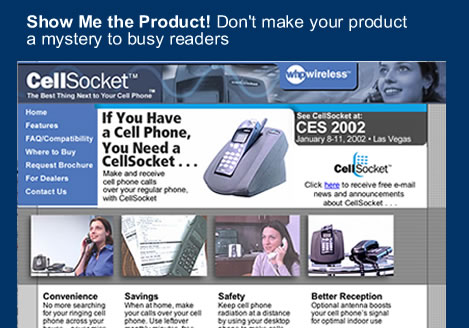
Your prospects want to see your product, and they want to see how it’s used—so show it to them!
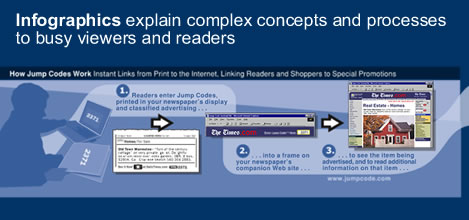
Your company sells a service, not a product, you say? Then use clean, clear, informational graphics to illustrate your service’s process, environment, or benefits (see below).
Informational Graphics are a Good Thing
For better or worse, we’re becoming less of a culture of readers and more a culture of viewers and picture-watchers. Adding word/graphic informational charts and diagrams to your marketing layouts (think USA Today-style graphics) helps you communicate essential product features, details, vision, and benefits faster (and usually better) than words alone.
Informational graphics can be used to illustrate these, and many other, important concepts:
• Key, proprietary product features, and their benefits;
• Product or service processes;
• Your product vs. the competition;
• Your company’s unique vision, and other “big picture” concepts
• Your product’s/service’s “new way,” vs. current way
By communicating important product benefits and features faster, and by communicating them to many of your prospects who won’t bother to read them in your ad copy, informational graphics enhance the communication power of your marketing deliverables, increasing their sales response.
What Do You Want the Reader To Do Next?
Your ad’s “call to action”—telling the reader what you want them to do next if they’re interested in taking the next step—is the final, and very important, design element of any marketing deliverable. At the very least, a call to action is an instruction to call or visit your company’s Web site, but can always be made more effective by adding a special offer, free premium, or savings promotion as an extra incentive for the prospect to act now.

Make sure this “call to action” instruction is prominent and plainly readable in all of your layouts. Interested readers always want to be told what they need to do next to take the next step closer to buying your company’s product, so make this part of your ad an important design feature of your layout, by using bold-faced type, setting type in a reversed-out solid color box, or using some other visual device to draw attention to your contact info and offer.
See an Ad You Like? Clip it!
Every art director keeps a “reference file” (also called a “swipe file”) of good design and layout ideas they’ve seen, by clipping and saving ads, brochures, flyers, collateral, and Web site links.
As a marketing manager, start your own reference file, but focus instead on clear expression of product benefits displayed in powerful headlines, and combinations of subheads, body copy, diagrams and informational graphics that seem clear and persuasive to you.
Then, use the design techniques you’ve seen in these ads to improve your ability to evaluate your company’s advertising layouts. Over time, you’ll also learn to see how design is used to enhance meaning, and how this improves the persuasive power of a layout, and how design can enhance the credibility of a company’s product presentation.
The Last, Most Important Piece of Advice
Here’s my last, most important design advice for marketing managers:
You are not a designer. So don’t try to be one. Don’t fiddle with layouts. It doesn’t matter whether a type box is where it is, or if it’s a quarter inch to the right, so leave it alone.
When it comes to marketing managers, I can always spot a hack by the amount of time he or she spends trying to re-design a layout. A pro, on the other hand, leaves design to the designer, and keeps an eye out for the important stuff, like whether or not the layout design sells the product.
Good commercial design is a skill requiring years of training and effort. Your ad agency hired your designer for a reason, and your ad’s art director knows more about design than you do.
So leave the design for designers. Instead, focus on how clearly and boldly your product’s sales benefits, descriptions, features, and call to action are presented in the layout, and make sure the way they’re designed and placed on the page serves to enhance the clarity, readability, and understanding of your product and its benefits.
Most competent designers who work for you are capable enough to design your ad layouts to a clean, acceptable standard, so be the stand-in for your reader and prospect: Focus on what you’re saying, and how clearly and persuasively you’re saying it, and let your designer do his or her job, which is to make the design of a marketing deliverable serve its mission to deliver this understanding to your market.
And this is all that you, as a marketing manager, need to know about advertising design and layout.
Next week, I’ll show you ways to make half-page (or even smaller) size ads pull just as well—or better—than full page ads. . .
Comments? Suggestions? Send them to me at eric@realmarkets.net
_____________________________________________________________
Eric Gagnon (eric@realmarkets.net), is president of GAA, a sales and business development consulting firm, and is the author of The Marketing Manager’s Handbook, the master study guide for the Business Marketing Association’s Marketing Skills Assessment, Skill Builder, and Certification (MSA/B/C) programs.
For more information on The Marketing Manager’s Handbook, available to BMA members at a special discount, link to:
http://www.businessmarketinginstitute.com/book.html
_____________________________________________________________
Test, Train, and Build Your B2B Marketing Skills for Better Sales Success: BMA Announces New Assessment, Training, and Certification for B2B Marketing Managers
For more information on the new BMA Marketing Skills Assessment, Skill Building and Certification (MSA/B/C) training and professional development program, visit http://www.businessmarketinginstitute.com