













 |
 |
 |
 |
Tuesday Marketing Notes (Number 102—November 13th , 2007)
MAKE SURE YOU CONTINUE TO RECEIVE EACH ISSUE OF TUESDAY MARKETING NOTES—CLICK HERE TO RENEW YOUR FREE SUBSCRIPTION
(NOTE: If you’ve already signed up previously at this link, no need to do so again)

Creating Accountable Advertising (Part 1)
By Rick Kean, CBC
It wasn't all that long ago that consumer agencies and marketers looked at those of us in business-to-business or industrial marketing as being unimaginative and plodding. And perhaps rightfully so. For us, a typical scenario was to lace almost all ad copy with unintelligible technical jargon; illustrate it with cross sections of some mechanical wonder and run ads in a bunch of magazines.
But, like the rest of the American business landscape, the times have changed in business-to-business advertising. Your prospects are exposed to your deliverables on a Web site, at a trade show, in direct mail, and in follow-up telemarketing. And since you're looking for better output, the input (your deliverable) will also have to improve. The role of strategic planning, market segmentation, prospect ranking, and those other disciplines historically associated with the most sophisticated consumer marketers are becoming routine components of B2B client relationships as well.
We're desperate for better results in a world where the old tools are becoming more expensive and less effective. Advertising doesn't work as well as it used to. That's due in part because there's so much of it, in part because people have learned to ignore it and partly because the Internet has provided more accessible information on products and services, and faster. The bottom line: companies that advertise better will do better.
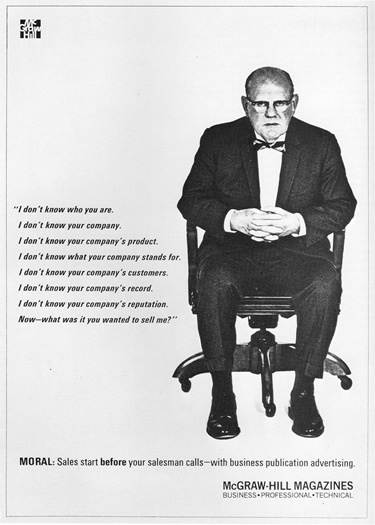
Picture that grumpy-looking old man in the chair in the old ad from McGraw-Hill (for those of you who remember it) where the copy reads:
I don't know who you are
I don't know your company
I don't know your company's product
I don't know what your company stands for
I don't know your company's customers
I don't know your company's record
I don't know your company's reputation
Now—what was it you wanted to sell me?
Too many advertisers have the wrong idea of how advertising works. They mistakenly think the publication brings the audience to the advertiser (actually, the publication brings the advertiser to the audience). The importance of this distinction is that advertisers usually tend to regard the publication's circulation as captive—ready to accept whatever he or she wishes to tell them. So they're tempted to tell them what they want them to know, rather than what the readers want to learn. Almost inevitably, the message is self-serving, boastful, pompous, or boring. In reality, the advertiser has only an opportunity—and a fleeting one at that—to communicate a message that will be of value to both parties. What you need for a good ad, above all else, is the discipline to stay unerringly zeroed-in on the interests of the targeted prospects. When you succeed in this, your ads can survive a multitude of other sins and still work. When you fail, they're useless.
Why do so many ads fail to attract and then hold a reader's attention? Because the two parties preparing the ads—the advertiser and the agency—tend to ignore the person they want to sell. Before starting the process of creating a campaign or an ad, one should consider these facts of advertising life: The dominating component in the advertiser-reader relationship is the reader, and the crucial factor in the communication is the reader's self-interest.
With an audience so receptive, the advertising people have no reason to think they must resort to tricks in order to attract and hold attention. No need for eye-popping layouts. No need for borrowed-interest illustrations. No need for curiosity-compelling headlines.
As we review the dozen reminders that follow, please remember that the ad-reading process is the result of a series of ("go, no-go") decisions. The reader encounters the ad: they either notice it or they don't notice it and they turn the page. If they notice it: they either relate to it or they don't relate to it and turn the page. If they relate to it: They either see something promising to them or they don't see anything promising to them and turn the page. And so on, and so on. At any point in the reader's progress through the ad, they may decide it is of no value to or telling them nothing new—and they turn the page. The purpose of our exercise is to help you reduce the "no go" occasions, where the reader does or should have an interest in the ad's subject.
Reach Out to the Reader
The ad must reach out from the page and draw in the attention of the reader who is moving quickly past it. On average, only a small number of ads in an issue of a magazine will capture the attention of any one reader. Some ads will be passed by because the subject matter is of no concern, but others, even though they may have something to offer, fail in the very first test of stopping the reader in their scanning of the pages. Ads perish at the start because, at one extreme they just lie there on the page, flat and gray, and at the other extreme, they are cluttered and hard to read. An ad should be constructed so that a single component dominates the area. That could be the picture, the headline or the text. Never the company name or logo. Obviously the more pertinent the picture, the more arresting the headline, the more informative the copy appears to be, the better.
Work upon the assumption that no one wants to read your ad. It's your job to catch the prospect's attention, hold that attention and lead them step-by-step from their original point of indifference to a point of interest.
Relate to Their Self-Interest
Very often, an ad is the first meeting-place between two parties looking for each other. So there should be something in the ad that at the reader's first glance will identify it as a source of information relating to their job interest, a problem they have, or an opportunity they would welcome. By means of either a picture or a headline, and preferably both, the ad should say right away: "Hey, hold it . . . this is for you." The idea is to get customers to raise their hands to volunteer to learn more.
Resist "Creativity"
The reader wants to learn something they don't already know, and it is the responsibility of the advertising to tell them—plain, unvarnished, unembellished. Much business-to-business advertising, unlike the advertising of consumer goods, is one company talking to another company, or perhaps even an entire industry. But, you can only tell your story to the world one person at a time. People read or listen alone. Absorbing an ad is an individual experience. Make your words sound as though you're talking directly to one person. Copy is most persuasive when it speaks to the reader as an individual—as if it were one friend telling another friend about a good thing.
First, of course, the terms should the terms of the reader's business, not the advertiser's business. The writing style should be simple. In business-to-business advertising, industry jargon is fine, but just make sure you've learned it thoroughly, because your readers can tell the difference. Lean towards short words, short sentences, short paragraphs, and active rather than passive voice. A more friendly tone always results when the copy refers to the advertiser in the first person, and the pronoun "you" should be used liberally. Advertising should be written the way people speak.
Promise a Reward
Never forget the reader's motive is gain. An ad will survive the qualifying round only if the reader is given reason to expect that if he or she continues on, they will learn something of value. The reward that the ad offers can be explicit or implicit, and could even be stated negatively in the form of a warning of possible loss. But the promise has to be specific, and believable. "Our Gizmo can reduce your maintenance costs," is not as effective as "Our Gizmo can reduce your maintenance costs 15%.” Five times as many people read headlines as will read the body copy, so you've got to make your headlines sell. Headlines are an ad for the ad.
Next week, in Part 2, we'll discuss "making it real," the "call-to-action," and other important aspects required to make advertising accountable . . .
Rick Kean, CBC, is Managing Director of the Business Marketing Institute, a Web-based skills building center for business-to-business marketers and marketing communicators. He can be reached at rkean@businessmarketinginstitute.com or at 312-371-5663.


Real Marketing: The Skills You Need for Business-to-Business Marketing Success, a 47-page overview of content covered by the BMI MSA/B/C Training and Certification System



Login Home Free Demo Free Newsletter Order NowContact Us
Copyright 2005-2007 Business Marketing Institute, LLC